
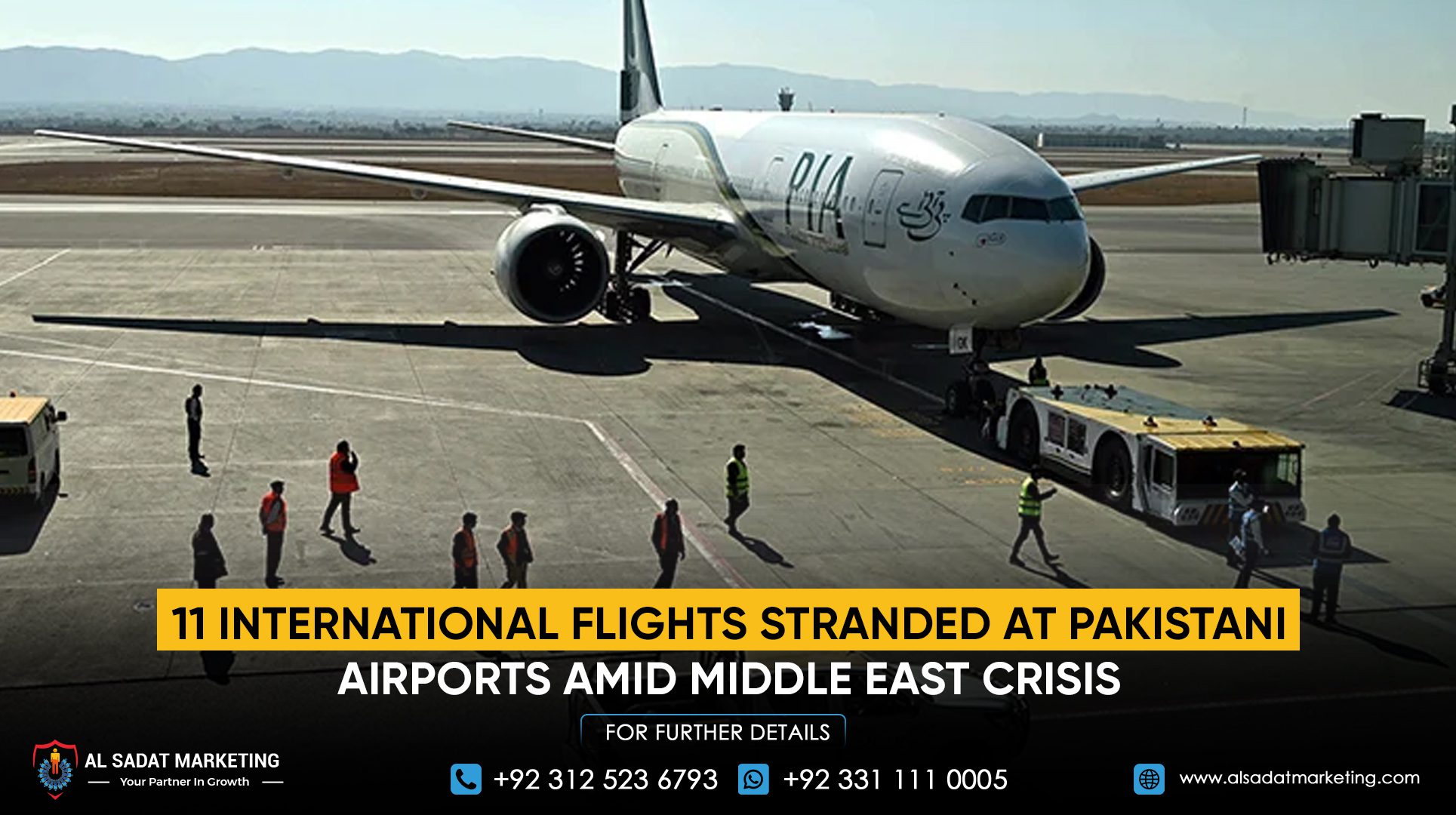
At least 11 international flights have remained stranded at airports across Pakistan for the past three days as tensions escalate in the Middle East following joint US and Israeli strikes on Iran.
The latest crisis began after the United States and Israel carried out coordinated attacks on Iran, triggering a renewed military confrontation in the region. Tehran responded with missile attacks targeting Gulf states and Israel, further intensifying hostilities.

As a result of the escalating conflict, flight operations across the Middle East have been severely disrupted.
In Pakistan, one foreign airline flight has been awaiting departure at Multan Airport for three days, while two other international flights remain grounded at Sialkot Airport. Airport officials say the delays are linked to regional airspace closures and operational uncertainties.
At the same time, overflights through Pakistani and Afghan airspace have surged as airlines reroute to avoid restricted zones in the Middle East. According to FlightRadar data, several routes passing through Pakistan and Afghanistan have become some of the busiest air corridors globally.
Major transit hubs in the Gulf, including Dubai and Abu Dhabi in the United Arab Emirates and Doha in Qatar, have either closed temporarily or operated under heavy restrictions. Dubai, one of the world’s busiest international aviation hubs, has been significantly affected.
The closures have disrupted global air travel networks, as Dubai and Doha serve as key connecting points between Europe and Asia. With aircraft and crew stranded at different locations, airline schedules worldwide have been thrown off balance.
Airlines across Europe, Asia, and the Middle East have canceled or rerouted multiple flights to avoid restricted airspace. These longer alternative routes have increased travel time and fuel costs. The situation has been further complicated by the limited availability of Iranian and Iraqi airspace, which has become more important after airlines stopped using Russian and Ukrainian routes due to the ongoing Russia-Ukraine conflict.
Aviation experts say the narrowing of available air corridors is increasing operational pressure on airlines. With multiple conflict zones affecting traditional flight paths, carriers are facing growing challenges in maintaining smooth international operations.