
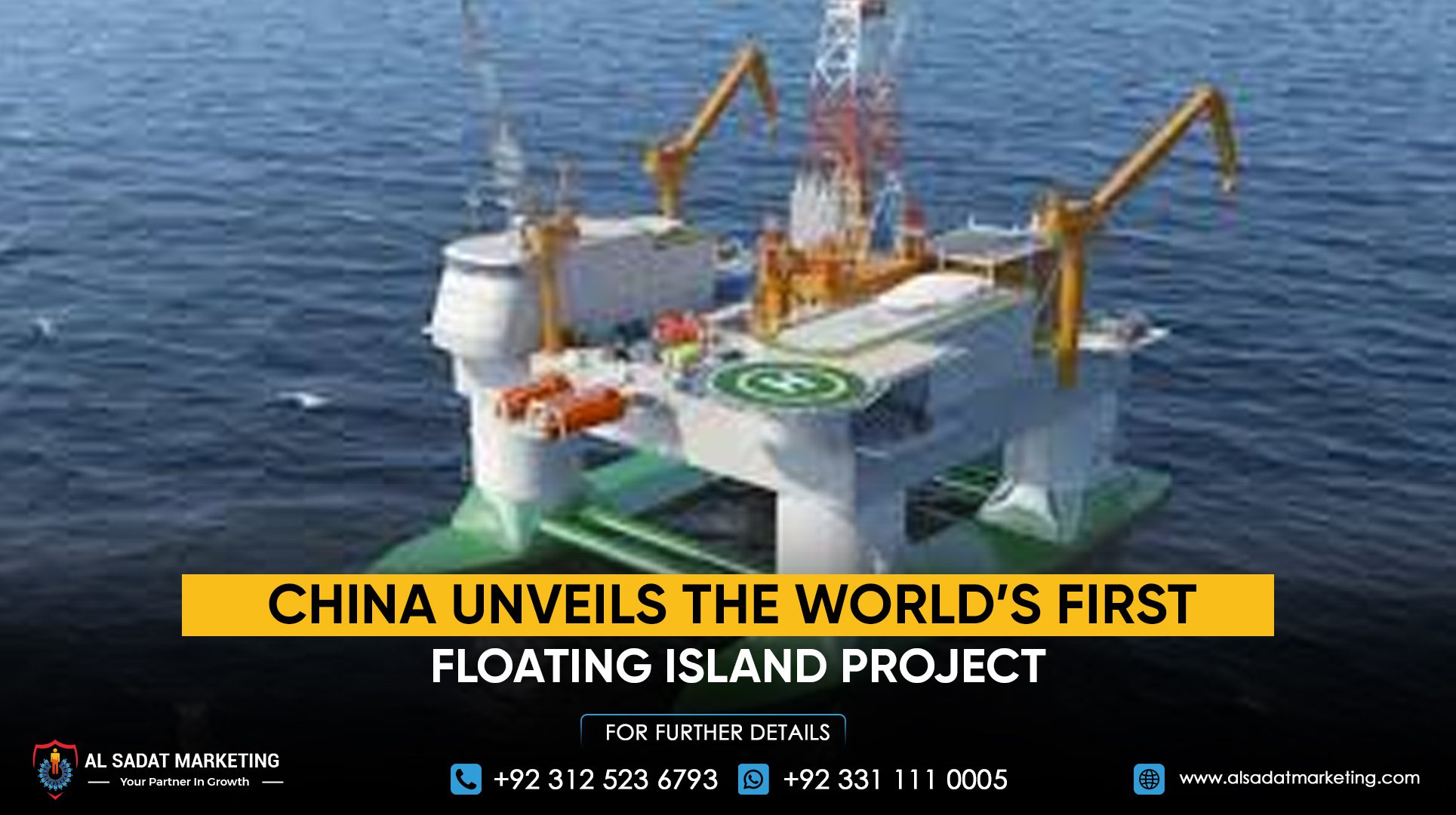
China has officially launched the “Open-Sea Floating Island,” the world’s first ultra-large marine research platform, marking a major step in advancing deep-sea scientific exploration.
The project is part of a national science and technology initiative and features a deep-sea, all-weather floating research facility designed to support studies in marine equipment, marine resources, and ocean science.

The platform consists of three integrated systems: a primary offshore structure, ship-based laboratories, and shore-based support facilities.
At the core of the project is a semi-submersible twin-hull design, allowing the platform to conduct full-scale testing of deep-sea equipment weighing hundreds of tons. It is also capable of supporting research at depths of up to 10,000 meters, significantly expanding the scope of marine exploration.
The project, led by Shanghai Jiao Tong University, is expected to be completed by 2030. Alongside the launch, the university has also established a dedicated institute for deep-sea science and engineering to further strengthen research capabilities.
Once operational, the platform will serve as an open-sea testing ground for technologies such as deep-sea mining systems, offshore oil and gas infrastructure, and advanced marine equipment.
Beyond industrial applications, the facility is expected to contribute to scientific discovery by helping researchers study seasonal changes in marine ecosystems, explore the origins and evolution of life, and improve the accuracy of typhoon forecasting, ultimately supporting better disaster prevention and mitigation efforts.