
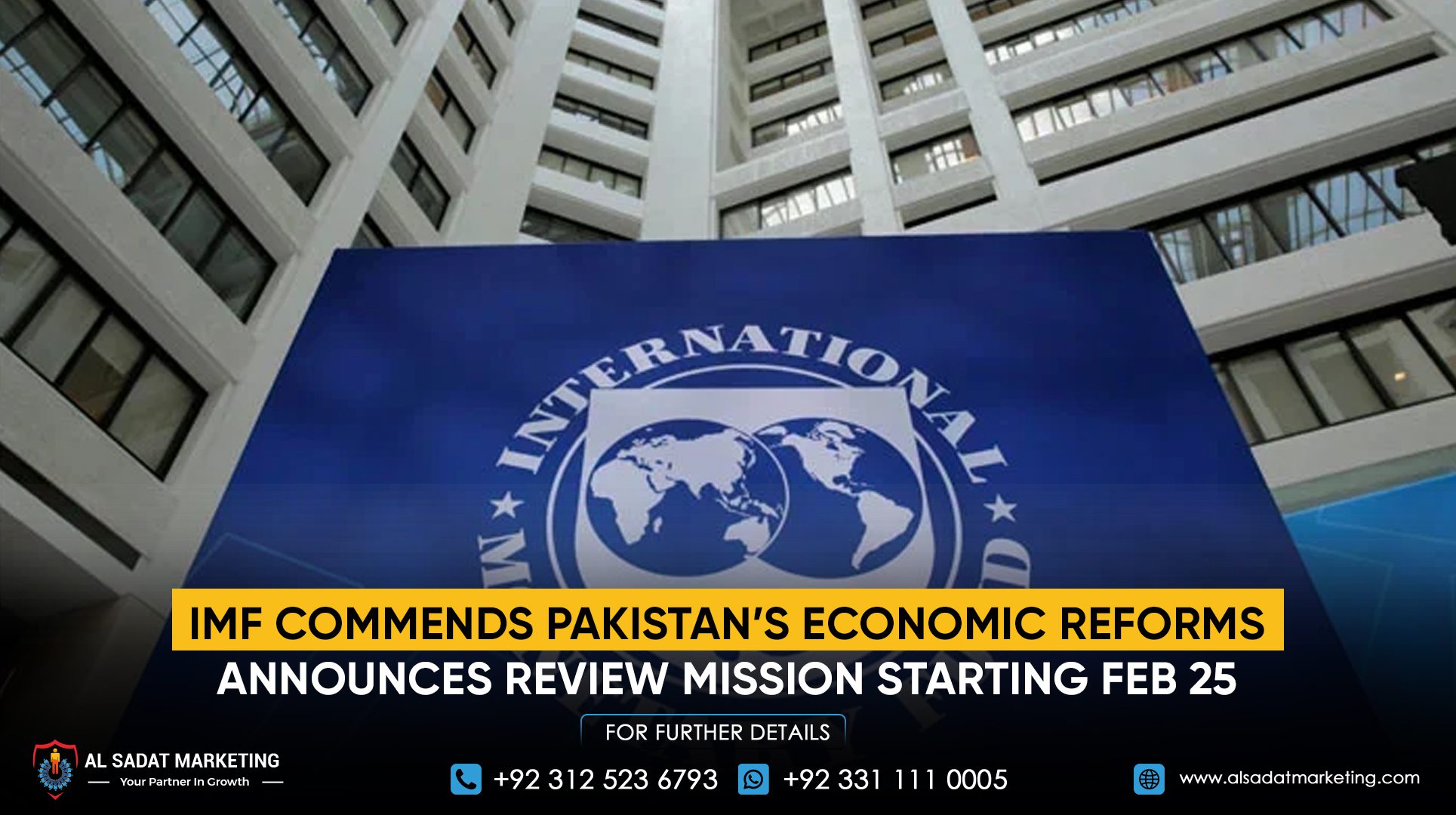
The International Monetary Fund on Friday welcomed Pakistan’s reform progress, stating that the country’s policy efforts under the IMF-supported programme have helped stabilise the economy and restore market confidence.
IMF spokesperson and Director of Communications Julie Kozack said Pakistan is currently implementing an Extended Fund Facility (EFF) arrangement. An IMF staff team is scheduled to visit Pakistan from February 25 to hold discussions on the third review under the EFF and the second review under the Resilience and Sustainability Facility (RSF).

Kozack noted that Pakistan’s reforms under the EFF have supported macroeconomic stability and gradually improved investor confidence. She highlighted that fiscal performance remains strong, with the country achieving a primary fiscal surplus of 1.3% of GDP in fiscal year 2025, in line with programme targets. Inflation has remained relatively controlled, and Pakistan recorded its first current account surplus in 14 years during the same fiscal year.
The Washington-based lender also recently published its Governance and Corruption Diagnostic Report, which outlines several reform recommendations. These include simplifying tax policies, ensuring fair competition in public procurement, and improving transparency in asset declarations.
In December last year, the IMF Executive Board approved a $1.2 billion loan for Pakistan after completing the second review of the country’s reform programme under the EFF.
Ahead of the upcoming IMF mission, Pakistan has prepared a 15-point action plan in response to the Governance and Corruption Diagnostic Assessment. The plan includes identifying the top 10 high-risk federal agencies with corruption vulnerabilities and significant macroeconomic exposure.
The government has also proposed measures to reduce the backlog of economic disputes. In the first year, it plans to develop and publish a methodology to assess the performance of courts and judges. In the second year, it intends to release a performance report covering administrative tribunals and special courts dealing with economic and commercial matters.
A detailed 240-page action plan outlines steps to strengthen governance and combat corruption. This includes creating a comprehensive framework to evaluate judicial performance and governance, along with improving alternative dispute resolution mechanisms to ensure more effective case management.
The government also plans to review the Anti-Money Laundering Act (AMLA) 2010 to remove legal ambiguities. A Joint Working Group under the AML/CFT Authority will examine whether a conviction for a predicate offence is required to prosecute money laundering cases and recommend necessary amendments. The revised legislation is expected to be presented to parliament and implemented by June 2027.
Additionally, the National Accountability Bureau (NAB) will prepare a national corruption risk assessment. A National Anti-Corruption Task Force, operating under the AML/CFT Authority and involving multiple agencies such as NAB, FIA, FBR, SECP and others, will coordinate efforts to develop a centralised framework for assessing corruption risks across government institutions.
The IMF’s statement signals continued engagement with Pakistan as the country moves forward with reforms aimed at strengthening governance, improving transparency, and maintaining economic stability.