
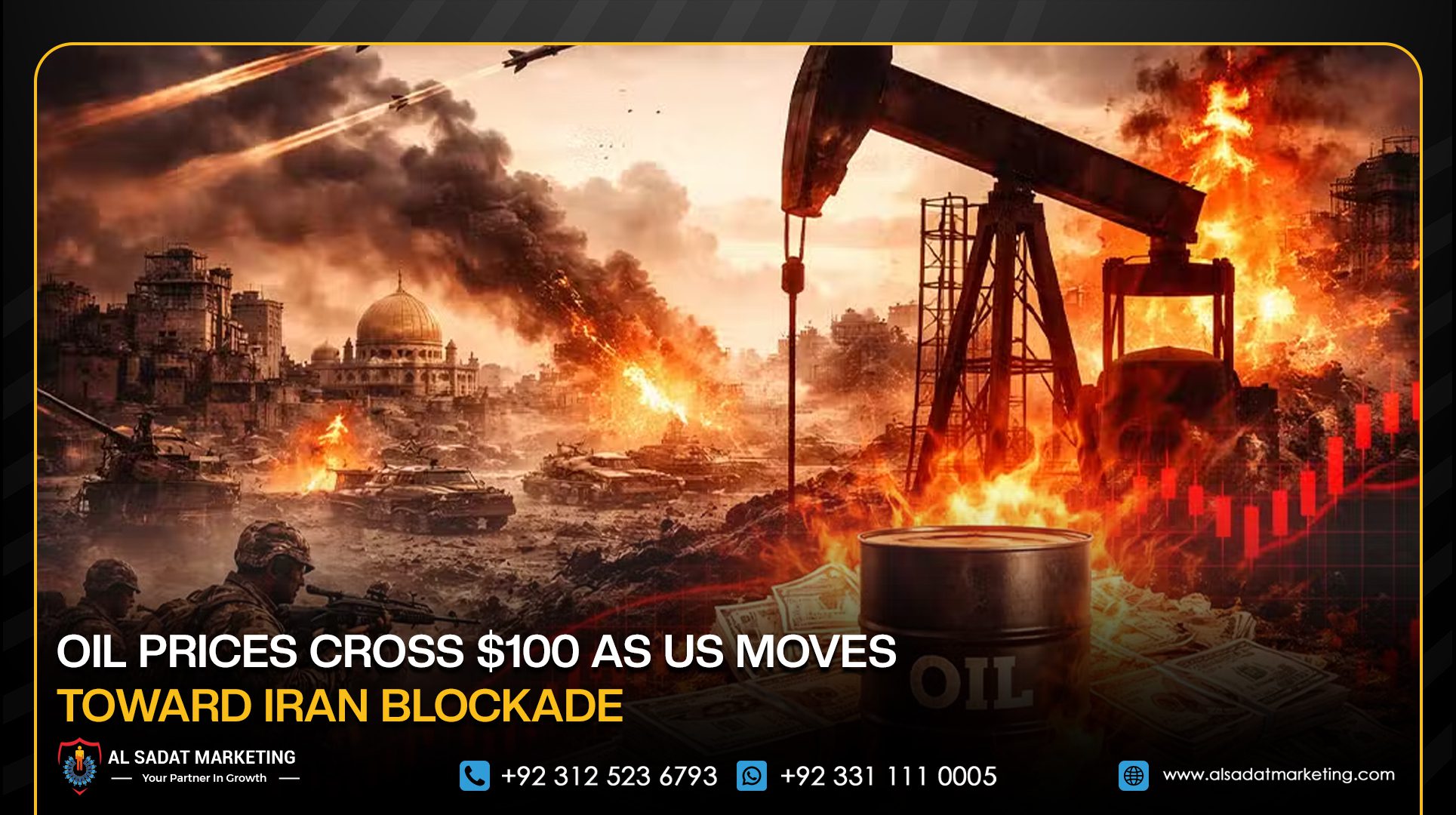
Oil prices surged sharply above the $100 mark on Monday after the United States announced plans to enforce a maritime blockade on vessels linked to Iran, escalating tensions in the Middle East and raising fresh concerns over global crude supply.
In early Asian trading, Brent crude jumped as much as 7% to $101.91 per barrel, while West Texas Intermediate (WTI) climbed nearly 8% to $104.16. The rally reversed losses from the previous session, as markets quickly priced in heightened geopolitical risk and potential disruptions to oil flows.

The spike followed comments by former US President Donald Trump, who said the US Navy would begin blocking maritime traffic associated with Iran after negotiations between Washington and Tehran failed to reach an agreement. The US Central Command (CENTCOM) later confirmed that enforcement would begin at 10 a.m. ET on Monday.
According to CENTCOM, the operation will focus on vessels entering or leaving Iranian ports in the Arabian Gulf and the Gulf of Oman. However, ships passing through the Strait of Hormuz for non-Iranian destinations will not be directly targeted.
Energy markets reacted immediately, with analysts warning that the move could significantly tighten global supply. Estimates suggest that up to 2 million barrels per day of Iranian-linked crude could be affected if the blockade is fully enforced.
“The market is essentially reverting to pre-ceasefire conditions,” said energy analyst Saul Kavonic. “Any disruption to Iranian-linked flows through Hormuz materially tightens the supply outlook.”
The Strait of Hormuz remains a critical chokepoint, handling around one-fifth of global oil shipments. Even limited disruptions in the area can trigger sharp price swings. Early tanker-tracking data indicates that some vessels are already avoiding the route in anticipation of increased risk.
Meanwhile, Iran’s Revolutionary Guards have issued warnings that foreign military vessels approaching the area could be seen as violating the fragile ceasefire, raising the possibility of further escalation.
Despite the rising tensions, some oil shipments are still moving. Over the weekend, three fully loaded supertankers successfully passed through the strait—the first since the ceasefire was announced—suggesting that some operators are cautiously continuing operations.
In a parallel development, Saudi Arabia said it has restored full capacity on its East-West pipeline, which can transport around 7 million barrels per day and provides an alternative route that bypasses the Strait of Hormuz.
Even so, the risk of prolonged disruption to Iranian exports and broader regional instability is expected to keep oil prices elevated in the near term, with traders closely watching military developments and shipping activity across the Gulf.