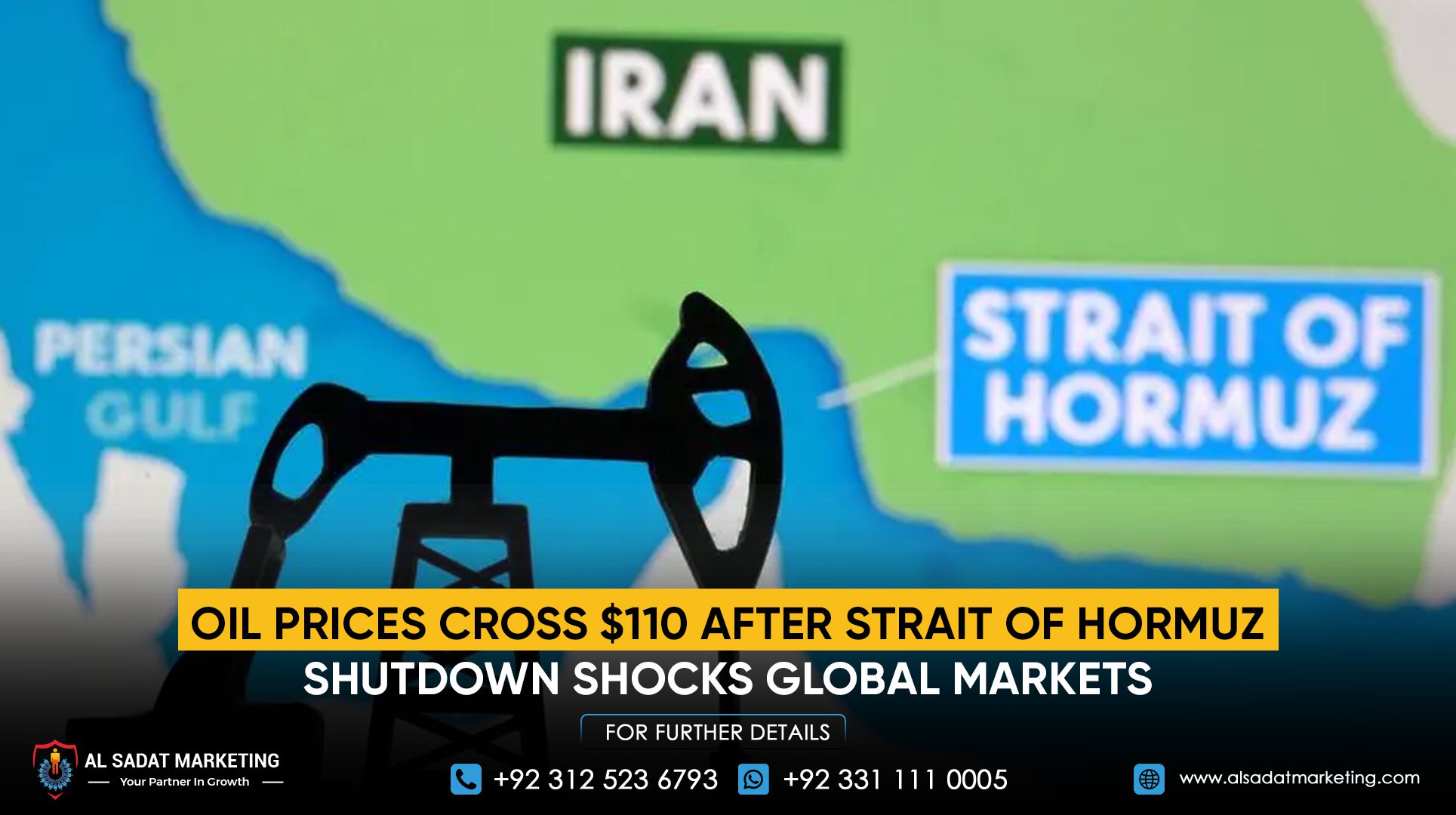
Crude oil prices rose above $110 per barrel on Sunday after several Middle Eastern oil producers reduced output while the Strait of Hormuz remained closed due to the escalating conflict with Iran, increasing concerns about a prolonged disruption in global oil supply.
The US benchmark West Texas Intermediate (WTI) surged 20% to $109.27 per barrel, while the global benchmark Brent crude increased by more than 18% to around $110 per barrel. US crude prices have jumped about 35% over the past week, marking the largest weekly increase since futures trading began in 1983.

The sharp rise in prices comes as major Gulf oil producers reduce production due to logistical difficulties caused by the closure of the Strait of Hormuz. The narrow waterway normally handles around one-fifth of the world’s oil supply, making it one of the most important shipping routes for global energy trade.
Kuwait, the fifth-largest producer in OPEC, announced precautionary cuts to crude production and refinery output on Saturday. The decision was taken due to security concerns and Iranian threats to shipping in the Strait of Hormuz. However, Kuwait Petroleum Corporation did not reveal the exact scale of the reductions.
Oil production disruptions appear even more severe in Iraq. Output from the country’s three main southern oilfields has reportedly fallen by around 70%, dropping to about 1.3 million barrels per day from approximately 4.3 million barrels before the conflict, according to industry officials.
The United Arab Emirates, OPEC’s third-largest producer, said it is carefully managing offshore oil production because of storage limitations, while its onshore operations continue to run normally, according to the Abu Dhabi National Oil Company.
Across the Gulf region, oil producers are facing growing storage challenges as tanker ships avoid passing through the Strait of Hormuz due to security concerns. Shipping companies are increasingly reluctant to use the route amid fears of possible Iranian attacks on vessels.
The conflict in the region shows little sign of easing. US President Donald Trump said the war was “already won,” while Iranian media reports suggested that Mojtaba Khamenei, the son of Supreme Leader Ayatollah Ali Khamenei, had been appointed as the country’s new supreme leader.
US Energy Secretary Chris Wright said that shipping through the Strait of Hormuz could begin returning to normal once Iran’s ability to threaten commercial vessels is reduced. He added that regular shipping activity might resume within a few weeks, though conditions have not yet returned to normal.