
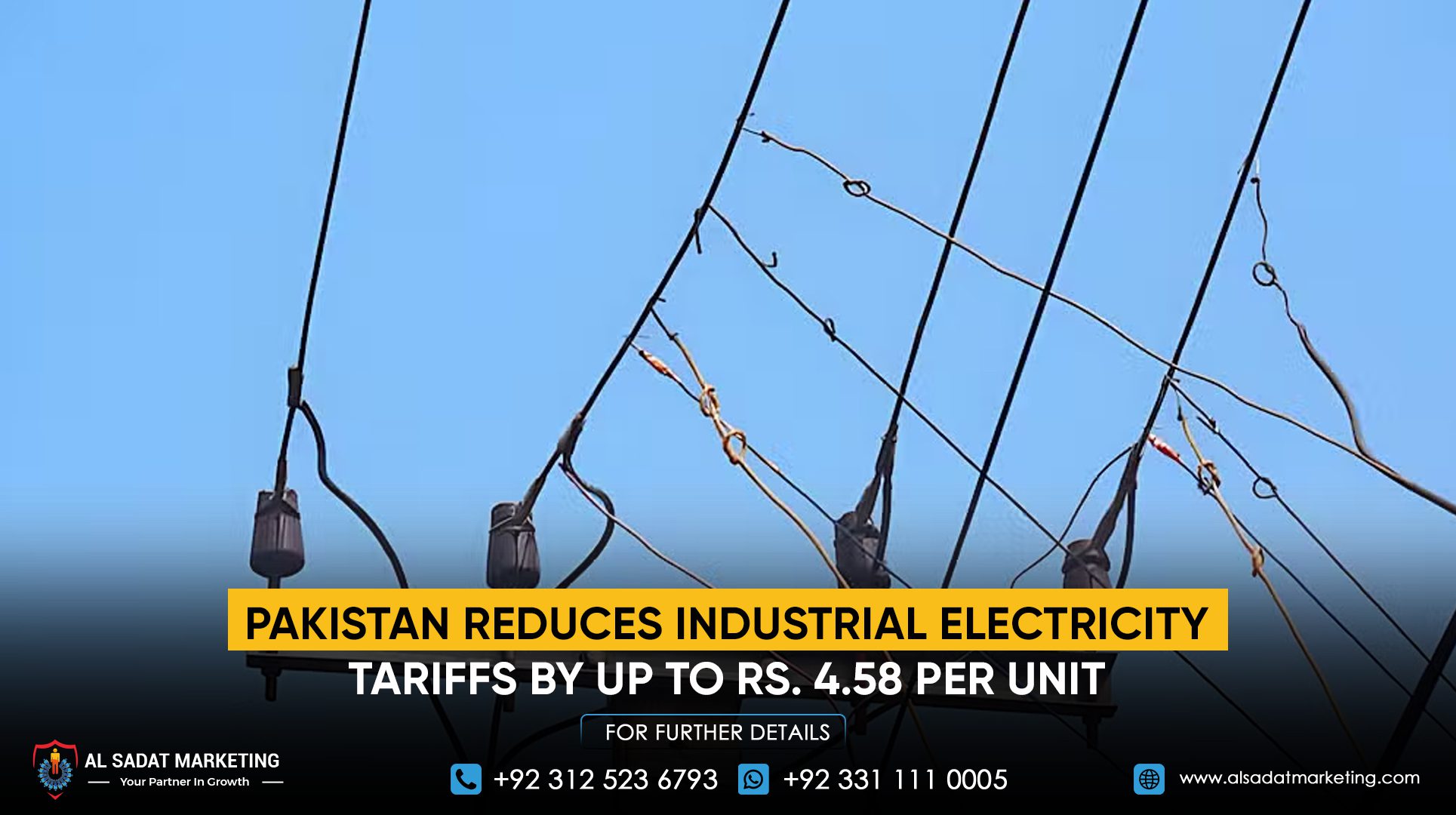
Pakistan has reduced electricity tariffs for industrial consumers across all major categories by up to Rs. 4.58 per unit, offering much-needed relief to factories and businesses facing high energy costs.
The federal government has formally notified the decision following a ruling by the National Electric Power Regulatory Authority (NEPRA) dated February 11, 2026. The revised rates took effect in February 2026 and will remain applicable to all distribution companies, including K-Electric, until December 2026. These new tariffs replace the rates announced in January.

Under the updated framework, small industrial consumers in the B1 category (up to 25 kW on low-tension supply) will now pay Rs. 26.23 per unit, down from Rs. 30.80. Peak-hour charges have been reduced to Rs. 35.74 from Rs. 36.74, while off-peak rates have dropped significantly from Rs. 30.05 to Rs. 25.48 per unit. However, B1 consumers will now pay a fixed monthly charge of Rs. 1,250 per consumer for the first time.
Medium-sized industries in the B2 category (25 to 500 kW) will see their energy tariff reduced from Rs. 30.73 to Rs. 26.16 per unit. Peak rates have been cut to Rs. 35.68 from Rs. 36.68, while off-peak charges have fallen sharply from Rs. 27.41 to Rs. 22.83 per unit. The fixed monthly charge remains Rs. 1,250 per kilowatt.
High-tension industrial consumers in the B3 category (11 to 33 kV) will now pay Rs. 27 per unit instead of Rs. 31. Peak-hour rates have declined to Rs. 35.68 from Rs. 36.68, and off-peak charges to Rs. 23.67 from Rs. 28.24. The fixed charge continues at Rs. 1,250 per kilowatt per month.
The largest industrial users in the B4 category (66 to 132 kV and above) will benefit from a reduction in energy charges from Rs. 30.43 to Rs. 26.43 per unit. Peak rates have been lowered to Rs. 35.68, while off-peak charges have dropped to Rs. 23.38 per unit. Fixed charges remain unchanged at Rs. 1,250 per kilowatt.
Overall, the revision reduces energy charges by roughly Rs. 4 to Rs. 5 per unit across most industrial categories. The biggest advantage comes from lower off-peak rates, which are particularly important for export-oriented industries and businesses operating continuous production processes.
For domestic consumers, lifeline users consuming up to 50 units and 51–100 units will continue to pay Rs. 3.95 and Rs. 7.74 per unit, respectively, without any fixed charge.
Protected domestic consumers using 1–100 units and 101–200 units will now face fixed monthly charges of Rs. 200 per kW and Rs. 300 per kW, respectively. Non-protected consumers will pay fixed charges ranging from Rs. 275 to Rs. 675 per kW per month, depending on their consumption slab.
Consumers using 301–400 units will see a reduction of Rs. 1.53 per unit, bringing the rate to Rs. 36.46. Those consuming 401–500 units will pay Rs. 38.95 after a Rs. 1.27 cut, while 501–600 unit users will see tariffs reduced by Rs. 1.40 to Rs. 40.22. Smaller reductions apply to higher slabs, with rates for usage above 700 units lowered by Rs. 0.49 to Rs. 47.20 per unit.
Lower-usage unprotected consumers and lifeline users will experience minimal or no changes, with tariffs continuing to range between Rs. 3.95 and Rs. 33.10 per unit.