
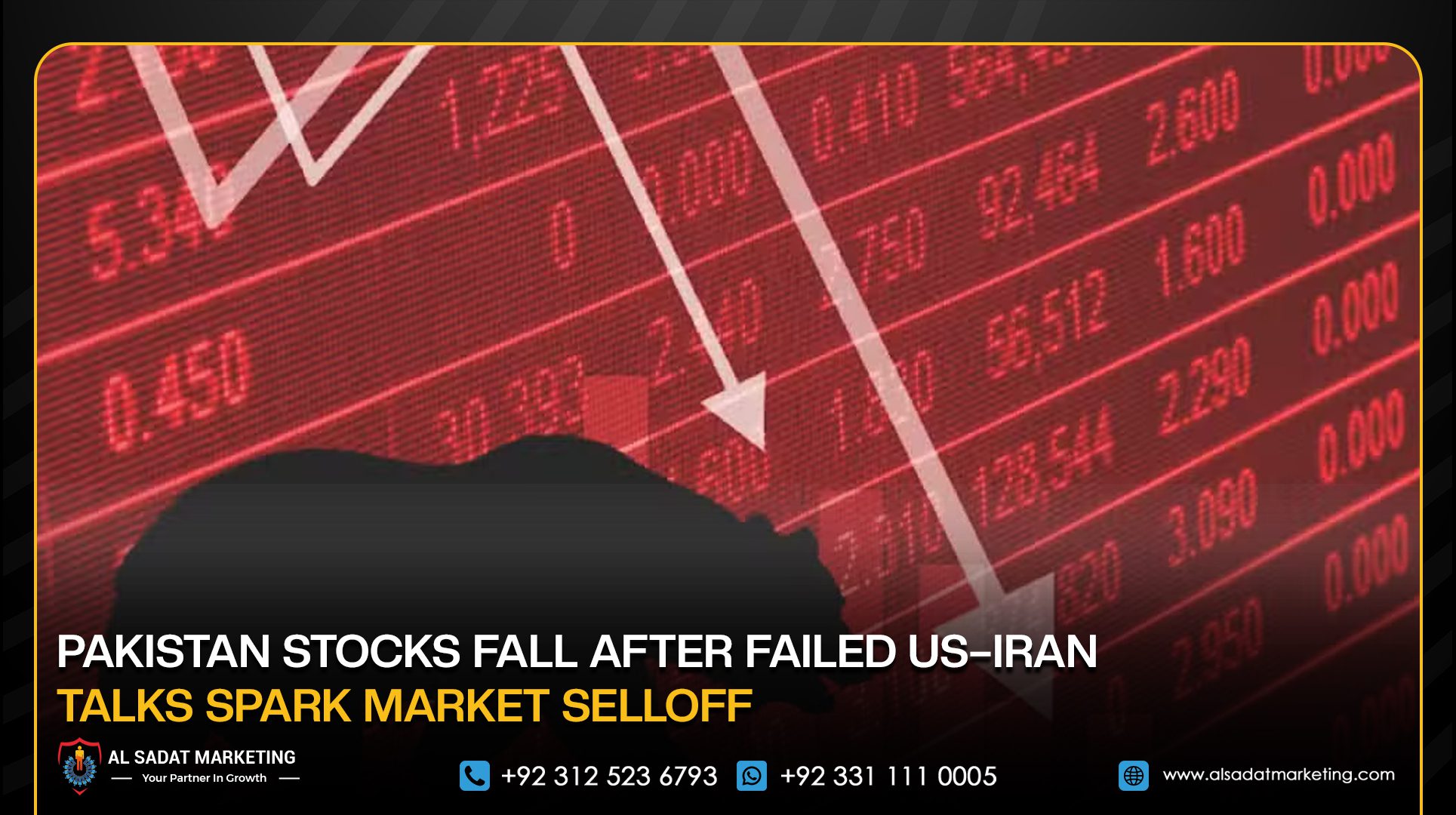
Pakistan’s stock market came under heavy pressure at the start of the week, as the benchmark KSE-100 Index plunged in early trading following a breakdown in talks between the United States and Iran, shaking investor confidence and sparking broad-based selling.
Within minutes of the market opening on Monday, the KSE-100 Index dropped nearly 4,800 points. By 9:34 a.m., it stood at 162,396.21, down 4,795.16 points, or 2.87%, reflecting a sharp shift in sentiment after last week’s optimism.

The selloff hit almost all major sectors, including automobiles, cement, commercial banks, oil and gas exploration, oil marketing companies, power producers, and refineries. Heavyweight stocks led the decline, with Attock Refinery Limited, Hub Power Company, Mari Energies Limited, Oil and Gas Development Company, Pakistan Oilfields Limited, Pakistan Petroleum Limited, Pakistan State Oil, Sui Southern Gas Company, Sui Northern Gas Pipelines Limited, and Wafi Energy Pakistan all trading in negative territory.
Market sentiment turned negative after US Vice President JD Vance said the American negotiating team was leaving Pakistan after roughly 21 hours of talks with Iran failed to yield any breakthrough. According to Vance, key disagreements remained, particularly over US demands tied to Iran’s nuclear program.
Iran also signaled little hope for an immediate agreement. Parliamentary Speaker Mohammad Baqer Qalibaf underscored ongoing mistrust between the two sides, highlighting the challenges facing future negotiations even after Pakistan facilitated indirect talks.
The latest setback has reversed last week’s rally in Pakistani equities, when hopes of easing geopolitical tensions had lifted the market. The KSE-100 Index had gained 1,673.87 points, or 1.01%, to close at 167,191.38, driven by expectations that progress between Washington and Tehran would reduce regional risk and improve investor appetite.
With diplomatic uncertainty back in focus, analysts expect volatility to persist in the near term as investors closely monitor geopolitical developments and their impact on the region’s economic outlook.