
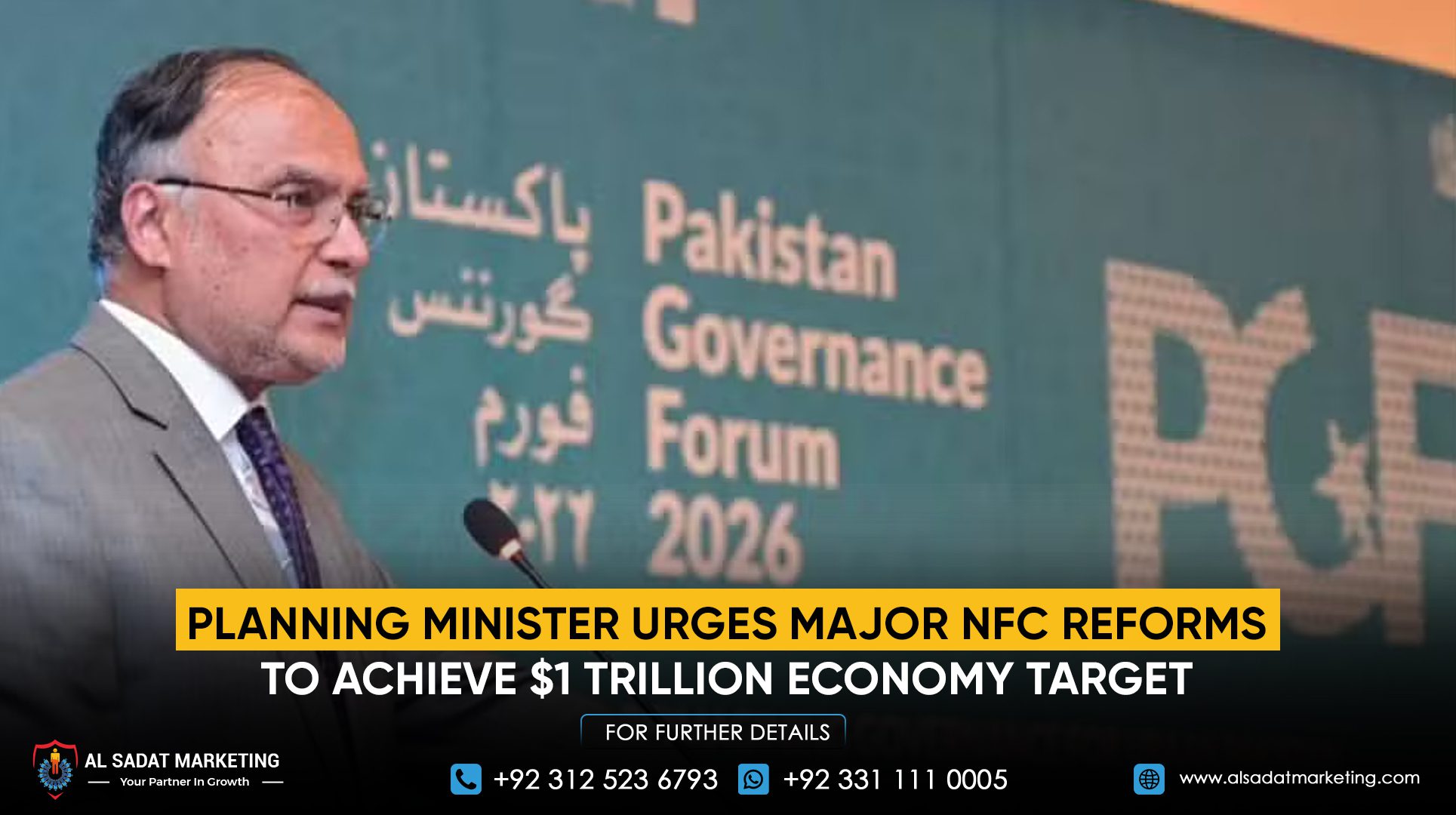
Federal Minister for Planning, Development and Special Initiatives Ahsan Iqbal has called for a comprehensive and forward-looking reform of the National Finance Commission Award (NFC) to help Pakistan move toward becoming a $1 trillion economy.
Speaking at a high-level forum organised by the Ministry of Planning, Development and Special Initiatives, the minister described the event as a major step in strengthening cooperative federalism. The gathering brought together the prime minister, chief ministers, federal and provincial ministers, parliamentarians, development partners, academics and policy experts for a national dialogue on fiscal federalism.

Iqbal clarified that the constitutional vertical distribution of resources between the federation and provinces is fully protected and not under review. He explained that the discussion focuses on horizontal distribution, how resources are allocated fairly across different units.
Highlighting fiscal pressures, the minister said that out of roughly Rs14 trillion in federal tax revenue and Rs5 trillion in non-tax revenue, about Rs8.2 trillion is transferred to provinces under the NFC Award. After these transfers, the federal government is left with around Rs11.07 trillion in fiscal space against total expenditures nearing Rs17.5 trillion.
He noted that nearly half of federal spending goes toward debt servicing, while about 25 percent is allocated to defence. After covering these obligations, the federation must finance pensions, salaries, development spending and social protection largely through borrowing, a situation he described as unsustainable.
Iqbal also pointed out that despite social welfare being a provincial subject after the 18th Constitutional Amendment, the federal government continues to fund major programmes such as the Benazir Income Support Programme (BISP), which costs around Rs716 billion annually. In addition, the federation bears financial responsibility for Azad Jammu and Kashmir, Gilgit-Baltistan and Islamabad Capital Territory.
He stressed the need to better align responsibilities with available resources and warned of growing imbalance in development financing. Provincial development allocations are now close to Rs3 trillion annually, while the federal Public Sector Development Programme (PSDP) has been reduced to around Rs1 trillion since 2018. He said throw-forward liabilities have reached nearly Rs11 trillion, creating a structural gap between commitments and fiscal capacity.
Discussing the current NFC formula, the minister raised concerns about incentive distortions. With 82 percent weightage assigned to population, he said there is little incentive for provinces to aggressively pursue population control. Similarly, linking 10 percent weightage to poverty may unintentionally discourage rapid poverty reduction.
He proposed revising the formula to reward poverty reduction, human development improvements, climate resilience, environmental sustainability and population stabilisation. He emphasized that climate change is now a structural challenge for Pakistan and should be reflected in fiscal allocations.
Iqbal also called for structured consideration of fiscal recognition for Azad Jammu and Kashmir and Gilgit-Baltistan, stating that constitutional complexities should not deny citizens equitable rights.
He urged revitalising the National Economic Council (NEC) as the key platform for aligning fiscal decisions with national development priorities. Without stronger coordination between the federation and provinces, he warned, fiscal stress would continue to weaken development outcomes.
Concluding his remarks, the minister said Pakistan’s fiscal challenges are serious but manageable with determination, policy continuity, political stability and sustained reform. He expressed optimism that institutional reforms in the NFC framework would support the government’s goal of achieving a $1 trillion economy by 2035 and pledged continued progress through structured national dialogue.