
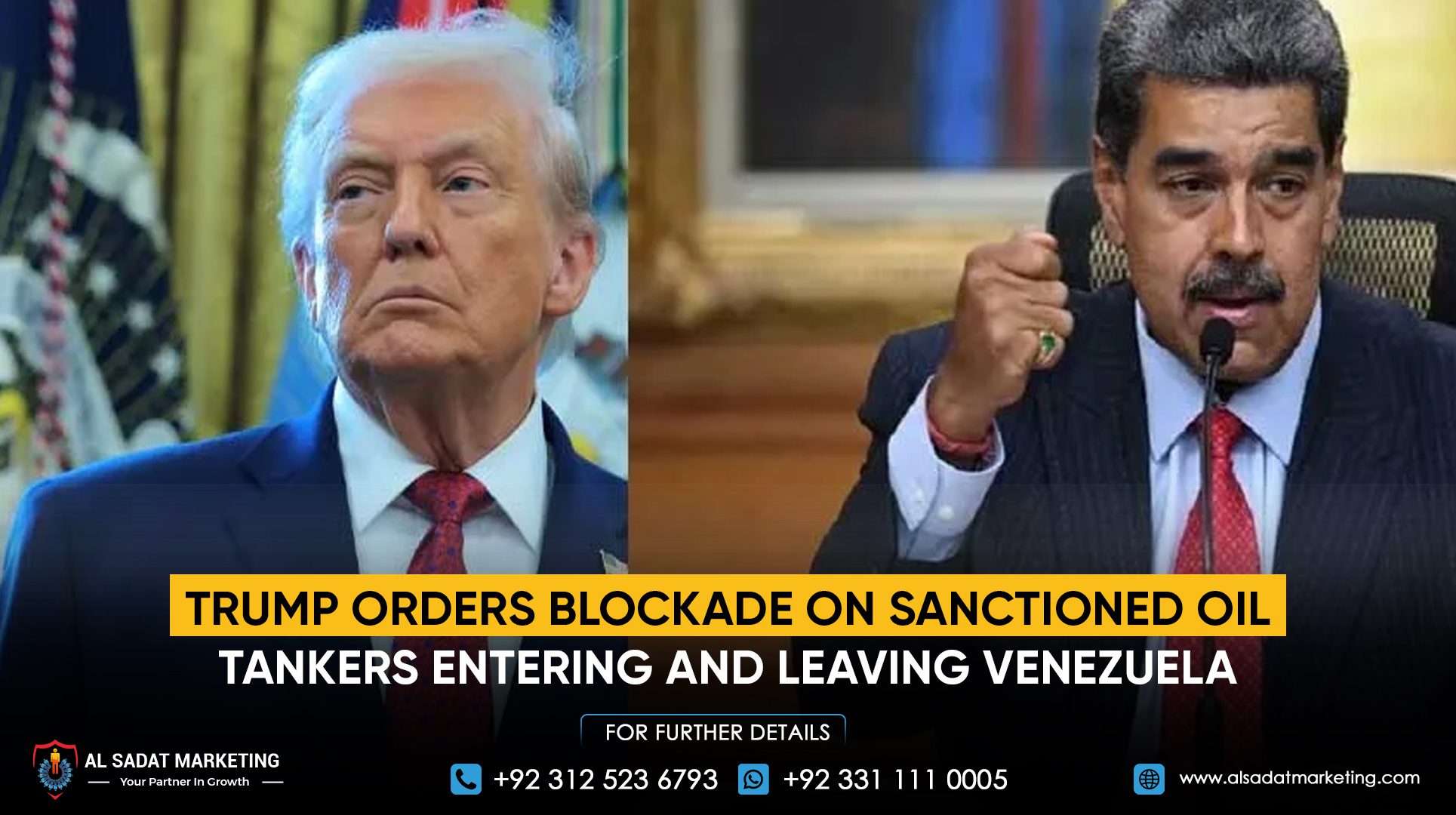
US President Donald Trump on Tuesday ordered what he called a “total and complete blockade” of all sanctioned oil tankers entering or leaving Venezuela, sharply escalating pressure on President Nicolás Maduro by targeting the country’s main source of income.
In a post on Truth Social, Trump accused the Venezuelan government of theft, terrorism, drug trafficking, and human trafficking, announcing that Venezuela had been designated a “foreign terrorist organization.” He said the blockade would apply to all oil tankers already under US sanctions. However, it remains unclear how the order will be enforced or whether the US Coast Guard will be used to intercept vessels, as happened last week.

The announcement comes as the Trump administration has significantly increased its military presence in the region, deploying thousands of troops and nearly a dozen warships, including an aircraft carrier. Venezuela’s government rejected the move, calling it a “grotesque threat” and condemning Washington’s actions.
Oil markets reacted quickly to the announcement. Oil prices rose more than one percent in Asian trading on Wednesday, driven by concerns that Venezuelan crude exports could fall further. Brent crude rose to around $59.60 a barrel, while US West Texas Intermediate climbed to nearly $56 a barrel. Market participants said prices were rising on expectations of tighter supply, though uncertainty remains over how strictly the blockade will be enforced and whether it will apply to vessels not currently sanctioned.
Legal experts have raised serious questions about the move. International law scholar Elena Chachko said blockades are traditionally considered acts of war and are subject to strict legal conditions. US Representative Joaquin Castro described the blockade as “an act of war” that had not been authorized by Congress and was not supported by the American public.
Venezuelan oil exports had already fallen sharply after the US seized a sanctioned tanker off the country’s coast last week. The situation has been worsened by a cyberattack that disrupted systems at state-run oil company PDVSA, further slowing exports. Many tankers loaded with Venezuelan oil are now remaining in local waters to avoid the risk of seizure.
China remains the largest buyer of Venezuelan crude, accounting for about four percent of its oil imports. Analysts say shipments to China were expected to average more than 600,000 barrels per day in December. While global oil supplies are currently sufficient, experts warn that if Venezuelan exports remain blocked for an extended period, the loss of up to one million barrels per day could push prices higher.
Former US energy diplomat David Goldwyn said a prolonged blockade could have severe consequences for Venezuela, including soaring inflation and a sharp rise in migration to neighboring countries. Since US energy sanctions were imposed in 2019, traders have relied on a “shadow fleet” of tankers, often sanctioned or linked to Iranian and Russian oil shipments, to move Venezuelan crude.
Tensions between Washington and Caracas have continued to rise. Trump has hinted at possible land strikes on Venezuela, while Maduro has accused the US of attempting to overthrow his government and seize control of the country’s vast oil reserves. Speaking earlier on Tuesday, Maduro said Venezuela would defend its sovereignty and insisted that peace would prevail despite what he described as imperial pressure.