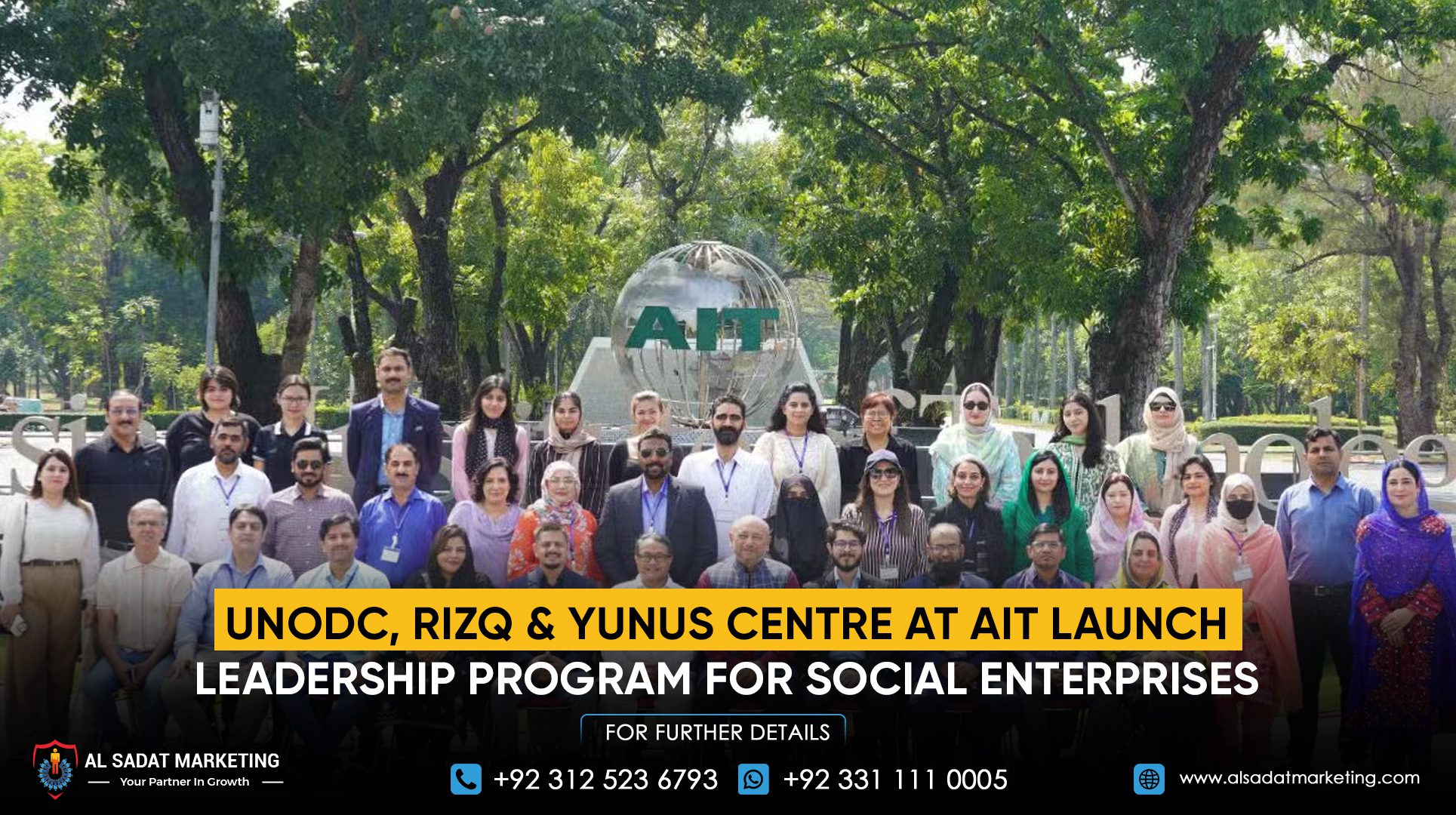
In a landmark initiative for Pakistan, the United Nations Office on Drugs and Crime (UNODC), Rizq, and the Yunus Centre at the Asian Institute of Technology (AIT) have jointly delivered a national Social Enterprise Development Leadership Program for faculty members from public sector universities. The initiative marks a significant step toward embedding social enterprise education within Pakistan’s higher education system, positioning enterprise-driven development as a pathway to peacebuilding and sustainable social impact.
The customized program brought together 26 faculty members from 19 public universities across the country, representing diverse academic disciplines. It was designed to strengthen institutional capacity by equipping educators with conceptual frameworks, practical tools, and international exposure to help promote social enterprise development within their universities and communities.

The 11-day immersive learning module was held at the Asian Institute of Technology in Thailand from January 15 to 26, 2026. The program combined expert-led academic sessions, applied learning workshops, field visits to established social business models, and faculty-led project presentations.
As part of the experiential learning component, participants visited several social enterprises in Thailand. These included STEP Café, which supports neurodivergent youth; the Stingless Bee Honey Cooperative, which sustains livelihoods through honey production, processing, and education; and Wat Chak Daeng, which converts plastic waste into usable materials. Delegates also visited the Population and Community Development Association (PDA) and the Embassy of Pakistan in Thailand.
Each organizing partner contributed distinct expertise to the initiative. UNODC, recognized globally for its prevention-focused development work, emphasized the role of social enterprise in creating productive opportunities for youth and addressing structural vulnerabilities. Prof. Hussain Haider, Senior Legal Expert at UNODC Pakistan, said engaging faculty members from across Pakistan reflects UNODC’s commitment to empowering youth through education. He noted that such initiatives contribute to peacebuilding by nurturing compassion, innovation, and responsible leadership.
Rizq, a leading Pakistani social enterprise with over a decade of experience in impact-driven models aligned with the Sustainable Development Goals, particularly SDG 2 (Zero Hunger), played a central role in designing and delivering the program. Musa Aamir, Co-founder of Rizq, described hosting faculty from across Pakistan as both an honour and a responsibility. He highlighted the country’s strong potential in social entrepreneurship and credited UNODC’s leadership for advancing enterprise-led solutions to social challenges.
The Yunus Centre at AIT, the first university-based centre of its kind, serves as a global hub for advancing Nobel Laureate Dr. Muhammad Yunus’ social business philosophy through education, research, and practice. At the closing session, Prof. Faiz H. Shah, Executive Director of the Yunus Centre at AIT, encouraged participants to inspire future generations to choose mission-driven social business leadership alongside traditional entrepreneurship.
Beyond capacity building, the program fostered cross-cultural exchange between Thai social business practitioners and Pakistani academics. The collaboration has established a foundation for future efforts, including curriculum integration, faculty-led social innovation projects, and the potential creation of social enterprise incubation hubs within participating universities. UNODC plans to expand the academic network further in the coming phases.
Reflecting on the initiative, Rizq CEO Qasim Javaid said that seeing Pakistani faculty engage with global social business models reaffirmed the country’s significant potential in the sector. He described the program as an important step toward developing a sustainable and locally rooted social entrepreneurship ecosystem in Pakistan.