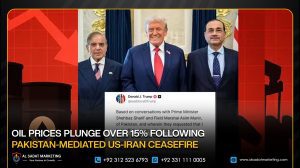

US President Donald Trump announced that the United States has agreed to suspend bombing and other military actions against Iran for two weeks under a ceasefire proposal facilitated by Pakistan.
Trump said the decision followed direct contacts with Prime Minister Shehbaz Sharif and Field Marshal Asim Munir, who urged restraint and pushed for diplomatic engagement. The ceasefire is conditional on Iran ensuring the immediate and safe reopening of the Strait of Hormuz, a critical global oil route.

Describing the arrangement as a “double-sided” ceasefire, Trump said Washington had received a 10-point proposal from Tehran that could serve as the basis for broader negotiations. He expressed optimism that the two-week window could lead to a more comprehensive agreement, noting that many key disputes have already been narrowed.
US officials also indicated that Israel has agreed to pause its military operations during the same period. However, the situation remains fragile, as reports of missile activity shortly after the announcement highlighted ongoing risks.
Iran signaled conditional acceptance of the proposal. Foreign Minister Abbas Araghchi said Tehran would halt defensive operations if attacks against it cease, and confirmed that limited safe passage through the Strait of Hormuz would be allowed during the two-week period.
According to Iranian officials, Pakistan conveyed that Washington had accepted Tehran’s 10-point framework as the foundation for talks. Formal negotiations between the US and Iran are expected to begin in Islamabad, with an initial two-week timeline that could be extended by mutual agreement.
Tehran emphasized that the ceasefire does not mark the end of the conflict, stating that any lasting resolution will depend on a final agreement over the proposed framework. It also warned that it remains prepared to respond if hostilities resume.
The development marks a significant diplomatic shift, with Pakistan emerging as a central mediator in one of the most sensitive geopolitical crises. The reopening of the Strait of Hormuz, which carries about one-fifth of global oil shipments, remains a key factor not only for regional stability but also for global energy markets.