
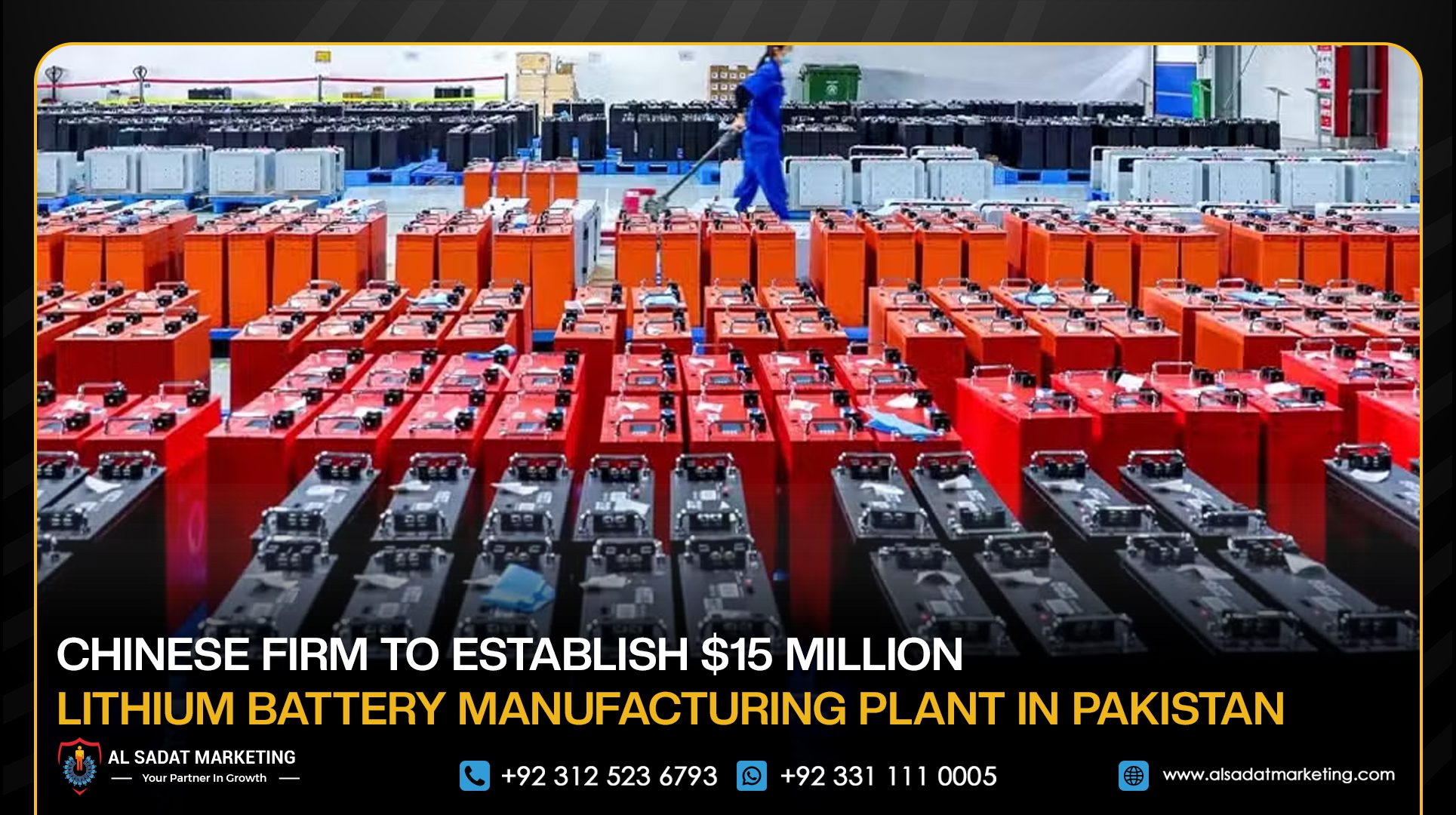
China’s Dongjin Group is set to establish a dry battery manufacturing plant in the Allama Iqbal Industrial City, Faisalabad, marking a fresh foreign investment in Pakistan’s expanding industrial sector.
The project, reported by the Associated Press of Pakistan, is expected to support rising demand for batteries in the country, driven largely by the rapid growth of electric vehicles and solar energy systems.
The company plans to invest $15 million in the facility, which will be developed within a Special Economic Zone near Faisalabad. The investment agreement has been formally signed with the Punjab Board of Investment and Trade (PBIT).
Officials say the decision was driven by strong market demand, particularly in sectors linked to renewable energy and electric mobility. According to PBIT representatives, the project is expected to stimulate industrial activity across multiple value chains while also supporting technology transfer to local industries.
The facility is expected to have wider economic spillovers, benefiting allied sectors such as automotive components, electronics, packaging, chemicals, and engineering services. It is also projected to generate employment opportunities in Faisalabad and surrounding areas.
Allama Iqbal Industrial City, part of the China-Pakistan Economic Corridor (CPEC) industrial framework, is one of Pakistan’s flagship Special Economic Zones. It offers modern infrastructure, connectivity advantages, and investment incentives designed to attract high-value manufacturing projects.
Under Pakistan’s SEZ incentive regime, the company will receive a 10-year income tax holiday, along with a one-time exemption on customs duties and taxes for the import of plant and machinery.
Industry stakeholders believe the project aligns with Pakistan’s broader push to localize battery production, particularly lithium-ion technologies used in electric vehicles and energy storage systems. Experts argue that strengthening domestic manufacturing could reduce reliance on imports and improve energy security.
Former Chairman of the Engineering Development Board, Almas Hyder, noted that global demand for batteries is rising due to the expansion of renewable energy and electric mobility. He added that Pakistan’s upcoming Battery Manufacturing Policy 2026–31 is expected to further encourage private investment in the sector.
Analysts also say that expanding local battery production could help reduce pressure on imported fuel and electricity costs while supporting the country’s transition toward cleaner energy systems.