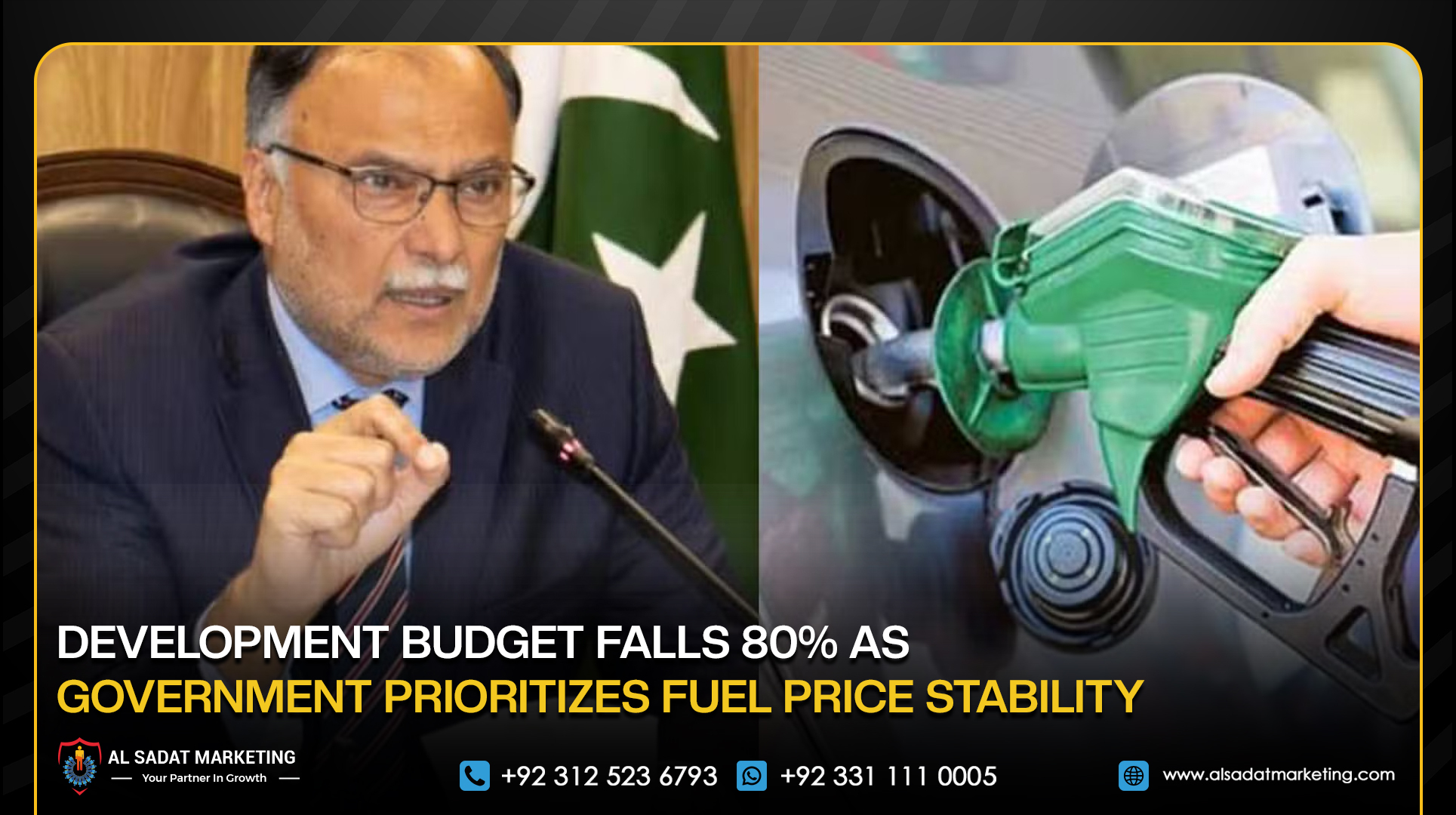
Pakistan’s development spending has declined by nearly 80 percent over the past eight years, with a growing share of public resources being used to manage economic pressures and energy-related subsidies instead of funding new development projects.
Speaking at the Annual Plan Coordination Committee (APCC) meeting, Federal Minister for Planning Ahsan Iqbal said the Public Sector Development Program (PSDP) has witnessed a sharp reduction in its share of the federal budget.
According to the minister, PSDP allocations accounted for 19.6 percent of the federal budget in FY2017-18, but have fallen to just 4 percent in FY2025-26, reflecting a significant contraction in development spending.
Fiscal Pressures Continue to Limit Development Spending
Ahsan Iqbal attributed the decline to rising debt servicing costs, economic challenges, and a series of external shocks that have reduced the government’s fiscal capacity.
He noted that a substantial portion of public funds has been directed toward economic stabilization measures and energy price differential subsidies, leaving limited room for development projects.
The minister said these financial constraints have reduced the government’s ability to invest in infrastructure and growth-focused initiatives despite increasing development needs across the country.
Government Calls for Shift Toward Export-Led Growth
Addressing participants at the APCC meeting, Ahsan Iqbal emphasized the need for Pakistan to move away from dependence on borrowing and adopt a more sustainable economic model.
He argued that long-term economic stability can only be achieved through higher exports, improved competitiveness, and stronger domestic resource mobilization.
“The PSDP is not merely a budget line but a statement of national intent,” the minister remarked while highlighting the importance of development spending for the country’s future growth.
IMF Program Seen as Part of Economic Recovery Effort
The planning minister described the ongoing International Monetary Fund (IMF) program as a necessary step toward economic stabilization, calling it a form of “economic therapy” required to address challenges stemming from past policy decisions.
He stressed that Pakistan must learn from countries such as China, Vietnam, South Korea, and Malaysia, which achieved sustained economic growth through industrialization, production, and export expansion.
Focus Shifts to Ongoing Projects
The APCC also reviewed development priorities under the government’s URAAN Pakistan framework.
Due to limited fiscal space, the committee approved a development strategy that prioritizes the completion of ongoing projects, with most available PSDP resources expected to be directed toward existing schemes rather than launching major new initiatives.
Officials acknowledged that while development spending remains constrained, the government aims to maximize the impact of available resources by focusing on projects that are already underway and close to completion.