
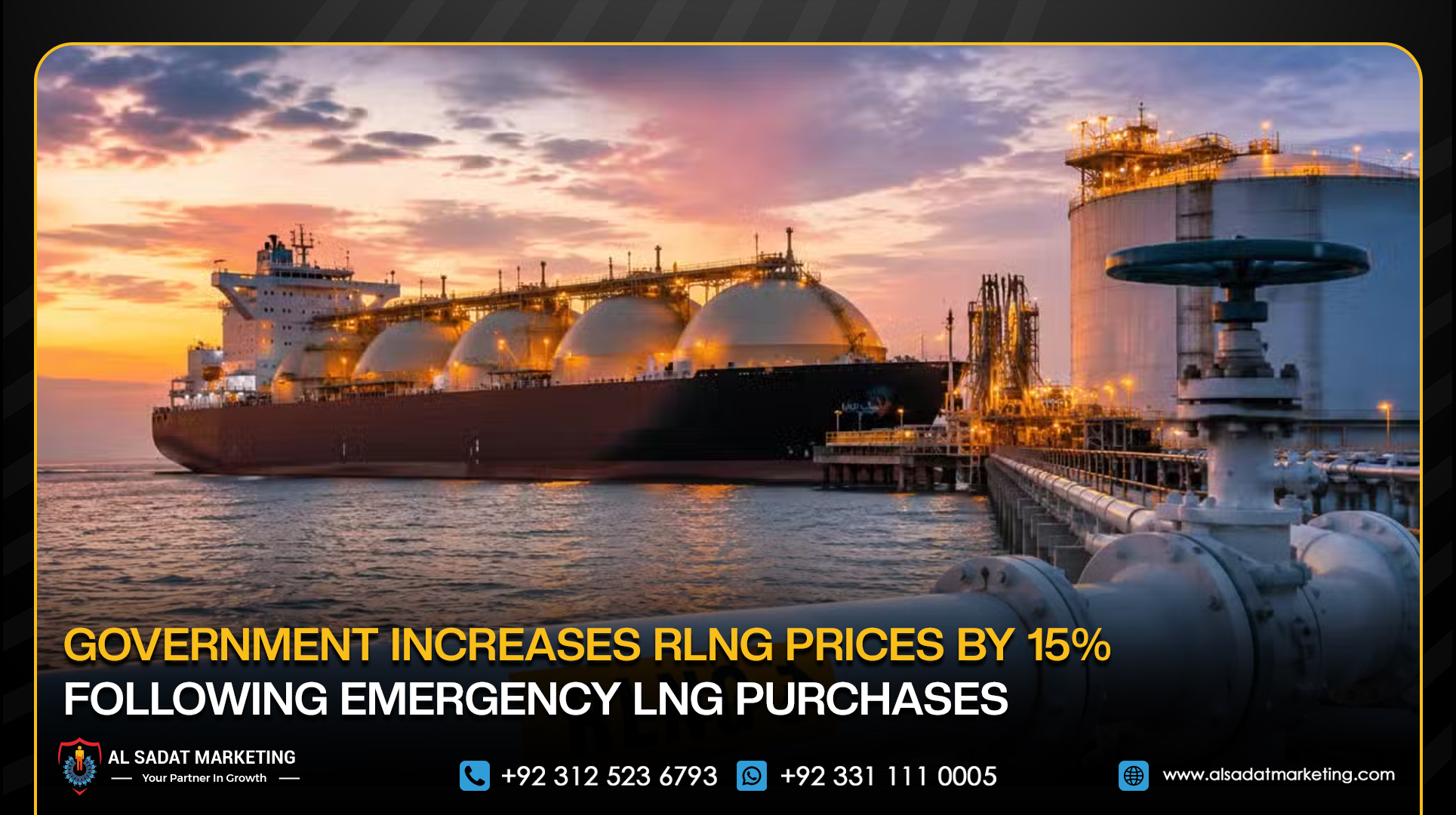
The Oil and Gas Regulatory Authority (OGRA) has increased the prices of Regasified Liquefied Natural Gas (RLNG) by around 15% for June, reflecting the higher cost of emergency spot LNG imports made after supply disruptions during the recent US-Iran conflict.
The revised prices represent a significant increase compared to recent months, with RLNG now costing nearly 56% more than in March and around 73% more than in February, adding to fuel costs for power generation and industrial consumers.
According to OGRA’s latest notification, the transmission-stage RLNG price for Sui Northern Gas Pipelines Limited (SNGPL) has increased by 14.85% to $17.94 per mmBtu, while the distribution-stage price has risen by 14.94% to $19.52 per mmBtu.
For Sui Southern Gas Company Limited (SSGCL), the transmission-stage price has increased by 16% to $16.37 per mmBtu, while the distribution-stage price has climbed 16.17% to $18.64 per mmBtu.
The increase follows Pakistan’s purchase of expensive LNG cargoes from the international spot market after supply disruptions caused by temporary shipping challenges in the Strait of Hormuz and interruptions to Qatar’s LNG exports during the regional conflict.
Three of the four LNG cargoes imported in June under Pakistan State Oil’s (PSO) long-term agreement with QatarEnergy were priced at an average of $13.14 per mmBtu, compared to approximately $9.20 per mmBtu in May. Meanwhile, Pakistan LNG Limited (PLL) imported an emergency spot cargo at $19.13 per mmBtu after resuming procurement activities.
OGRA said the higher import costs, along with distribution losses, port charges, retainage, and supply chain margins, have contributed to the increase in domestic RLNG prices.
The impact has also been reflected in the power sector, where RLNG-based electricity generation costs rose to Rs. 31 per unit in May, more than double the Rs. 13.72 per unit recorded in April, increasing pressure on electricity generation costs and future tariffs.
According to OGRA, around two-thirds of PLL’s June LNG cargo will be supplied to K-Electric, while the remaining volume will be allocated to SNGPL for distribution to consumers.