
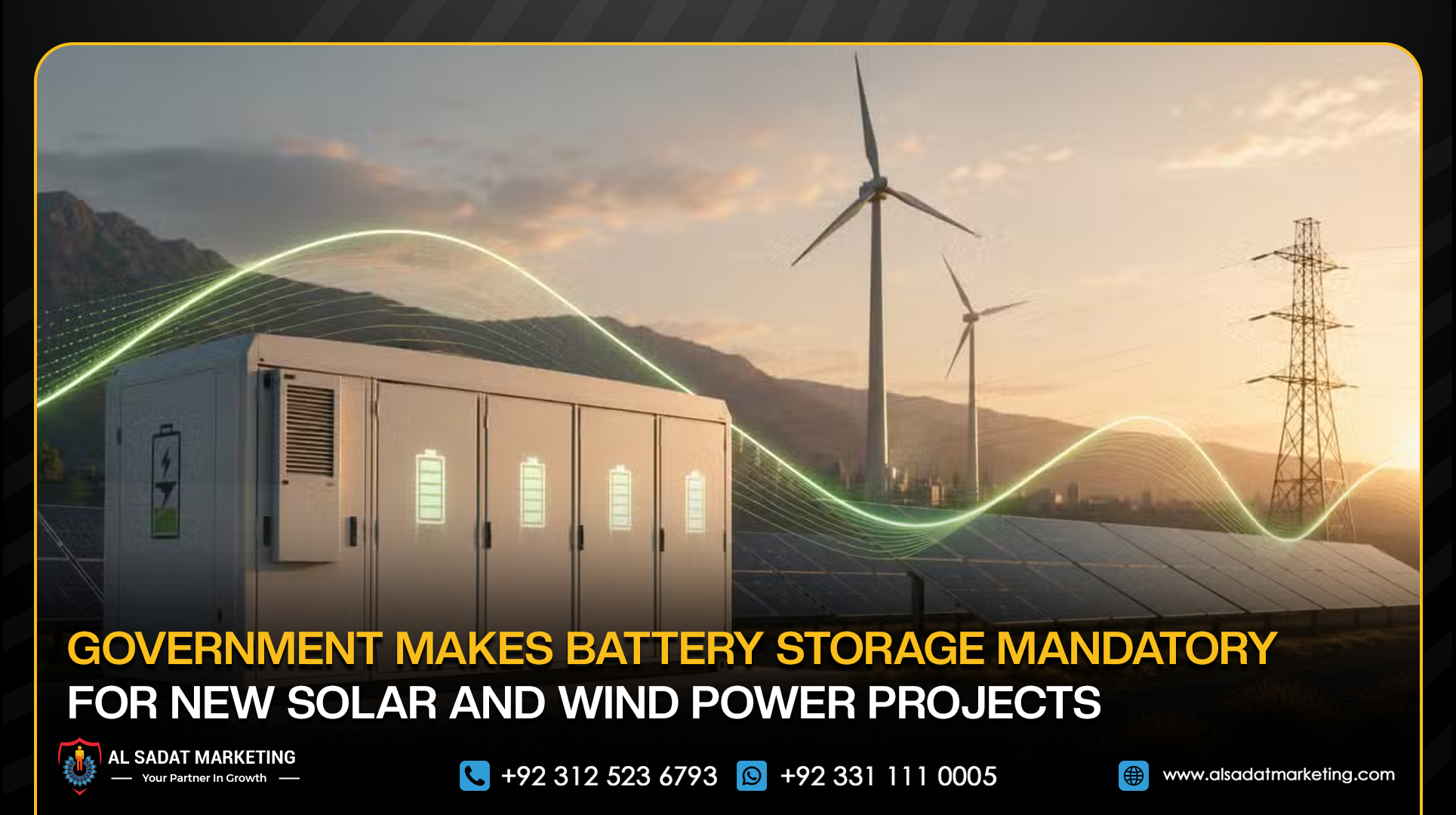
The federal government has decided to make Battery Energy Storage Systems (BESS) mandatory for all participants in its upcoming 800 MW renewable energy auction, aiming to improve grid stability as solar and wind power generation continues to expand across the country.
The new requirement will apply to Pakistan’s first electricity wheeling auction, where surplus power generation capacity will be offered through a competitive bidding process. Under the proposed framework, developers will be required to install battery storage systems with a capacity equal to at least 10% of their project’s firm generation capacity alongside their solar or wind facilities.
Move Aims to Improve Grid Stability
According to the Independent System and Market Operator (ISMO), the introduction of mandatory battery storage is intended to reduce grid congestion, minimize renewable energy curtailment, and address Pakistan’s growing “duck curve” challenge.
The duck curve refers to the sharp drop in electricity demand from the national grid during daylight hours due to increased solar power generation, followed by a rapid surge in demand after sunset. Battery storage will help store excess electricity during the day and supply it during peak evening hours, improving overall grid flexibility.
Developers Can Install Larger Battery Systems
ISMO’s financial analysis suggests that integrating battery storage can not only strengthen grid performance but also improve the financial viability of renewable energy projects.
While 10% battery storage has been proposed as the minimum requirement, project developers will have the flexibility to install larger battery systems if they believe additional storage will enhance project performance and profitability.
Stakeholders Support the Proposal
The proposal follows consultations with prospective bidders and other stakeholders, the majority of whom supported introducing mandatory battery storage during the initial phase of Pakistan’s competitive electricity market.
ISMO noted that several countries, including India, China, the Philippines, and the Dominican Republic, have already adopted similar battery storage requirements for renewable energy projects.
Additional Auction Reforms Proposed
Alongside the battery storage requirement, ISMO has recommended allowing the auction submission deadline to be extended when necessary.
Under the existing framework, bidders have only one month to submit proposals, with no provision for deadline extensions. ISMO believes greater flexibility may be required during Pakistan’s first competitive renewable energy auction if multiple participants request additional time.
New Grievance Committee Suggested
ISMO has also proposed establishing a Grievance Redressal Committee comprising two independent board members and the organization’s chief executive.
The committee would handle complaints submitted by bidders, replacing the current system in which the auction committee is responsible for both evaluating bids and deciding objections related to those evaluations.
Proposal Sent to NEPRA
The proposed amendments have been submitted to the National Electric Power Regulatory Authority (NEPRA) for approval. The regulator has invited stakeholders to submit their comments and feedback within seven days before making a final decision on the proposed framework.