
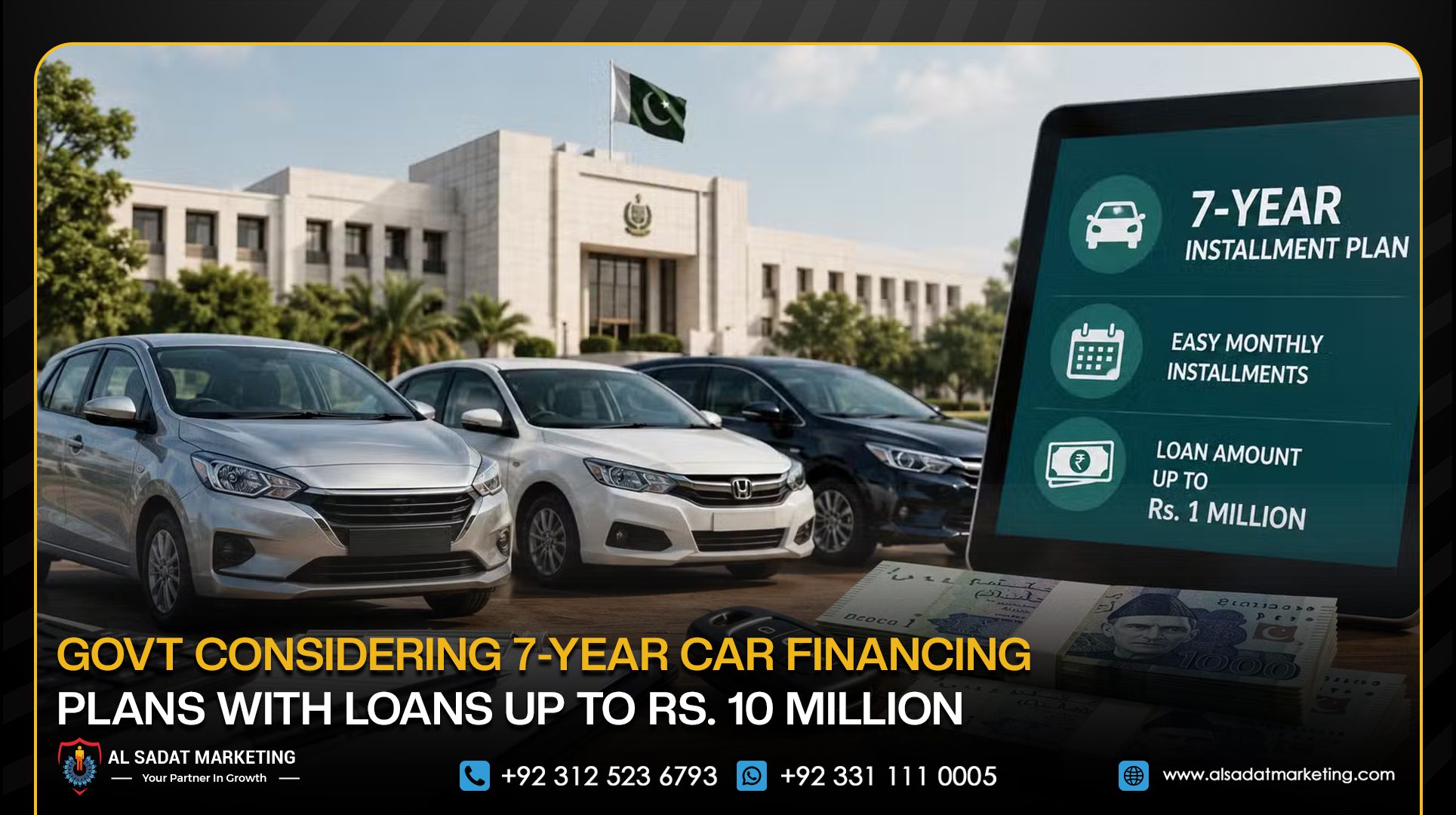
The federal government is reviewing a new set of more affordable auto financing reforms under the draft Auto Industry Development & Export Policy (AIDEP) 2026–31, according to sources familiar with the matter.
The proposed changes are aimed at reviving car financing activity and improving affordability for consumers, with a financing limit set at up to Rs. 10 million.
Sources said the draft policy, currently under discussion with the State Bank of Pakistan and industry stakeholders, includes several key measures such as extending auto financing tenure to seven years, reducing the minimum down payment requirement to 15 percent, and introducing a Rs. 10 million cap for eligible locally manufactured vehicles.
These steps are intended to restore consumer purchasing power following a prolonged period of high interest rates, tighter lending conditions, and rising vehicle prices that have significantly slowed car sales.
Under the proposals, used vehicle imports would be gradually liberalized through a regulated framework. This would include mandatory certification and inspection requirements, compliance checks, a phased reduction in tariff premiums from 40 percent to zero by FY2030, and a depreciation cap of 30 percent.
For consumers, the draft policy also suggests fixed booking prices, penalties for delivery delays beyond 30 days at KIBOR + 3 percent, a cap of 20 percent on advance booking payments, warranty responsibility assigned to original manufacturers or authorized importers, and a maximum 20 percent markup on spare parts at authorized dealerships.
The overall framework is designed to expand access to vehicle ownership, boost domestic production, encourage localization, and shift demand toward locally assembled vehicles rather than imports.
Sources added that easier financing conditions could significantly stimulate demand in Pakistan’s struggling auto sector while also supporting activity in related vendor industries. However, they emphasized that these remain draft proposals subject to regulatory review, consultations with the banking sector, and approval by relevant cabinet committees.
Policy Targets Under Consideration
The draft policy outlines broader targets to be achieved by 2031, including annual vehicle production of over 500,000 units, $1 billion in auto exports, a 30 percent share of new energy vehicles (NEVs) in new sales, production of 100,000 tractors annually, and establishment of 3,000 EV charging stations.
It also proposes the gradual phase-out of Additional Customs Duties by FY2029, an 80 percent reduction in Regulatory Duties by FY2030, and the elimination of major SRO-based concessions by the same year.
Import duties on Completely Built Units (CBUs) for cars and SUVs would be progressively reduced to improve competition, affordability, and access to newer technologies.
Sources further indicated that CKD duties for cars, SUVs, and minivans would be reduced from 30 percent to 20 percent over five years. Duties for tractors, buses, prime movers, heavy commercial vehicles, and two- and three-wheelers would largely be maintained or rationalized.
NEV incentives would continue but become increasingly tied to localization requirements, with EV components shifting into structured tariff or SRO frameworks.
The draft also envisions a nationwide rollout of 3,000 EV charging stations by 2030, including fast chargers, Level 1 and Level 2 chargers, and battery-swapping facilities. It proposes fixed commercial charging tariffs, viability gap funding, and a requirement for oil marketing companies to install Level 3 chargers at 10 percent of their stations in each province.
Additional NEV promotion measures include free registration and token tax exemptions in Islamabad, proposed toll relief, government procurement of NEVs, development of an Islamabad Electric Mobility City, and an ICE-to-NEV conversion program starting in December 2027.
Domestic value addition targets would be performance-linked and digitally monitored through the Pakistan Single Window system. These include 80 percent DVA for sub-1000cc cars, 55 percent for SUVs, 50 percent for NEVs, and 85 percent for two- and three-wheeler NEVs by FY2031.