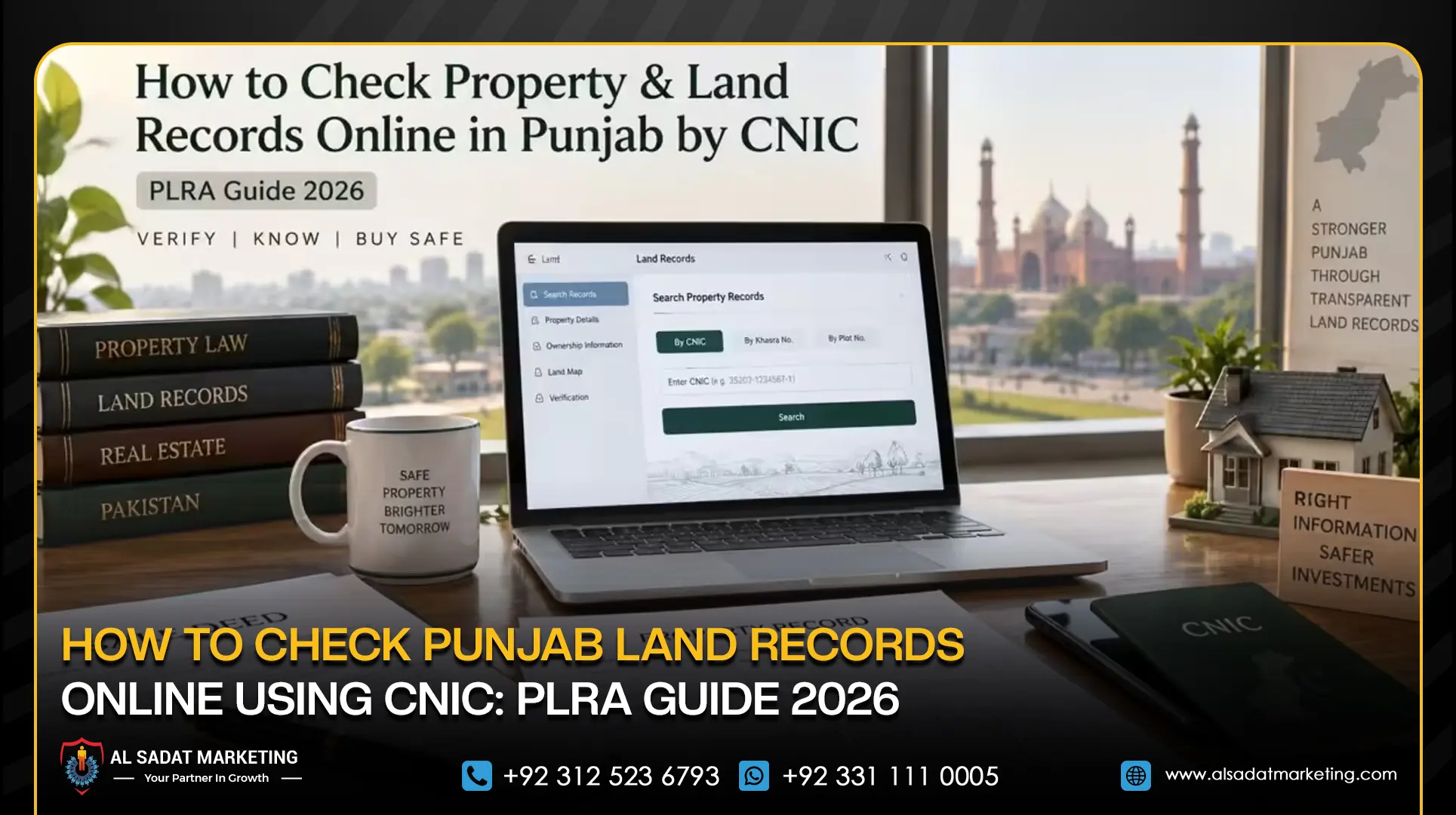
LAHORE: Checking property ownership and land records in Punjab has become more accessible through the digital services of the Punjab Land Records Authority (PLRA). Property owners, buyers, and sellers can use these services to obtain or verify records such as Fard, Registry, and Intiqal, along with other property-related information.
However, one common misconception needs clarification: having a person’s CNIC does not mean you can simply search the internet and obtain a complete list of every property registered in that person’s name.
CNIC information is used by PLRA to identify and authenticate individuals during land-record and property transactions. In most cases, the relevant property details are also required to locate and verify a specific land record.
Can You Check Punjab Property Records Using CNIC?
Yes, a CNIC is an important part of Punjab’s computerized land-record system, but it should not be understood as an unrestricted public property-search facility.
Depending on the service and transaction, applicants may need information such as the district, tehsil, mouza, Khewat number, Khasra number, Registry details, or other property identifiers.
For a property buyer, the practical process is therefore to combine CNIC verification with the actual land and ownership record.
A typical verification process involves:
- Identify the recorded owner.
- Keep the owner’s CNIC available for identity verification.
- Collect the property’s relevant land-record details.
- Obtain the latest Fard where applicable.
- Verify the Fard through the official PLRA system.
- Review Registry information where relevant.
- Check the latest Intiqal or mutation.
- Compare ownership names and shares across the documents.
- Verify the housing scheme and exact plot separately if applicable.
- Complete legal and physical due diligence before paying a token.

What Is PLRA?
The Punjab Land Records Authority is responsible for computerized land-record services across Punjab.
Its digital and authorized service facilities help citizens access several property-related services, including:
- Fard issuance
- Fard verification
- Intiqal and mutation services
- Registry and e-Registration
- Property transfer services
- Historical Registry information
- Property valuation-related services
- CNIC entry and identity-related land-record services
- Green Property Certificate services
These services serve different purposes, so obtaining one document does not necessarily replace the need for other checks.
What Information Do You Need?
The information required depends on the type of property and service being requested. Buyers should generally have as much of the following information as possible:
- Owner’s CNIC
- Owner’s full name
- District
- Tehsil
- Mouza
- Khewat number
- Khasra number
- Registry details
- Property size
- Ownership share
- Previous transfer or ownership documents
If you are purchasing property, avoid relying solely on details provided by a dealer or seller. Ask for the underlying documents and compare them with the official record.
How to Get a Fard in Punjab
A Fard is an important land-record document used to establish the recorded position of a particular property or parcel of land.
Depending on the available service, a Fard can be obtained through PLRA’s online system or an authorized land-record service facility.
When reviewing a Fard, pay particular attention to:
- Owner’s name
- CNIC information
- Father’s or husband’s name, where applicable
- Land area
- Khewat number
- Khasra number
- Mouza and tehsil
- Ownership share
- Latest mutation or transfer position
If the person selling the property is different from the person shown as the recorded owner, the reason should be established before proceeding. The seller could be acting through a valid Power of Attorney, inheritance, guardianship, or another legal arrangement, but the supporting authority must be properly verified.

How to Verify a Fard Online
Obtaining a Fard and verifying it are two separate steps.
This distinction is particularly important when a seller provides a scanned copy, photograph, or screenshot of a document.
PLRA provides an online facility for verifying Fard and Intiqal documents. Buyers should use the official verification mechanism whenever the document is eligible for online verification.
The basic principle is:
Obtain the document, verify the document, and then compare it with the seller’s identity and the actual property.
A screenshot sent through WhatsApp should never be treated as the final proof of ownership.
What Is Intiqal or Mutation?
Intiqal, commonly referred to as mutation, records a change in ownership or another relevant change in the land record.
An Intiqal may be associated with transactions such as:
- Sale
- Inheritance
- Gift
- Court orders
- Other legally recognized ownership changes
This is important because an old Registry may show that a transaction took place in the past, while subsequent inheritance, sale, gift, partition, or another transaction may have changed the current ownership position.
For this reason, buyers should examine the latest land record rather than relying exclusively on an old document.
Fard vs Registry vs Intiqal
These three terms are often confused during property transactions, but they perform different functions.
| Record | General purpose | Why it matters |
| Fard | Extract of the relevant land record showing ownership and property information | Helps establish the current recorded position |
| Registry | Registered deed documenting a property transaction | Provides evidence of the relevant registered transaction |
| Intiqal / Mutation | Entry recording a change in the land/revenue record | Helps establish whether an ownership change was entered into the record |
A buyer should ideally understand how these documents connect rather than relying on one document in isolation.

Can You Check an Old Registry?
Historical Registry information can help establish the ownership trail of a property.
Old documents may show how ownership was transferred from one party to another, but an old Registry does not automatically prove that the same person remains the current owner.
Where historical records are available digitally or through authorized channels, they can be useful for reviewing the property’s transaction history.
For a current purchase, however, historical documents should be compared with the latest Fard, Intiqal, and other relevant records.
What If the CNIC Is Not Linked to the Land Record?
Some older property records may not contain complete or properly linked CNIC information, particularly where records originated from earlier manual systems.
If the owner’s identity information is missing or incorrect, PLRA provides mechanisms for updating or entering CNIC information into the computerized land record.
Buyers should not ignore discrepancies between the seller’s CNIC and the ownership record.
The same caution applies if:
- The owner’s name is significantly different.
- The CNIC belongs to another person.
- Ownership shares do not match the proposed sale.
- One of several owners is missing from the transaction.
- The seller claims the mutation is still pending.
- Someone is selling on behalf of another person without properly verified authority.
Such discrepancies should be resolved before money changes hands.
What Is the Green Property Certificate?
Punjab has also introduced the Green Property Certificate as part of its digital land-record initiatives.
The certificate is designed to provide electronically generated information relating to the ownership and status of a specific property, with identity verification forming part of the process.
While such digital services can make property verification easier, buyers should not assume that one certificate replaces every other legal or regulatory check.
The applicable documentation depends on the property and transaction.
Land Ownership Is Different From Housing Scheme Approval
One of the most important points for property buyers is that land ownership verification and housing-scheme approval are separate matters.
A person may have an ownership record for land, but that does not automatically mean a housing scheme, extension, block, or particular plot is approved for development.
Similarly, a housing society may have an approved portion while another extension or block may have a different regulatory status.
Therefore, if you are buying a plot in a private housing project, verify:
- Approved layout plan
- NOC status
- Exact approved area
- Block or extension
- Plot number
- Development permissions
- Land ownership
- Transferability
Do not stop at asking whether the housing society itself is “approved.” The more useful question is whether the exact plot and area being offered are covered by the relevant approval.
Does a Clean Fard Mean the Property Is Safe to Buy?
Not necessarily.
A verified land record is an important part of property due diligence, but it does not answer every question a buyer should ask.
Before paying a token, also check:
- Whether the seller is legally authorized to sell
- Whether there are co-owners
- Whether the property is mortgaged or pledged
- Whether a court dispute or stay order exists
- Whether the property is subject to acquisition
- Whether society or development charges are outstanding
- Whether the property is transferable
- Whether possession is genuine
- Whether the physical property matches the documents
- Whether the exact plot falls within the approved layout
The land record should therefore be treated as one layer of a wider property verification process.

Physically Verify the Property
Digital records are valuable, but property should also be checked on the ground.
Before completing a transaction, compare the documents with the actual location and verify:
- Boundaries
- Dimensions
- Access road
- Possession
- Neighbouring properties
- Encroachments
- Physical demarcation
- Plot location
- Development status
A buyer can have genuine documents but still be shown a different piece of land or a property with an access or boundary problem.
Check Property Valuation and Transaction Costs
Once ownership and legal status have been reviewed, buyers should also calculate the financial obligations associated with the transaction.
Market price, official valuation, taxes, transfer charges, and society fees are not necessarily the same thing.
Before finalizing the purchase, determine the applicable:
- Property taxes
- Registration charges
- Stamp duties
- Society transfer fees
- Development dues
- NDC requirements
- Outstanding installments
- Other transaction-related charges
The final amount should be confirmed through the relevant government authority or housing society because tax rates, fees, and procedures can change.
Practical Punjab Property Verification Checklist
For someone actually purchasing property, the following sequence can help organize the process:
1. Verify the seller
Match the seller’s original CNIC with the ownership record.
2. Identify the exact property
Collect the relevant Khewat, Khasra, Registry, plot, block, mouza, district, and tehsil details.
3. Obtain the latest land record
Review the current Fard instead of relying on an old copy.
4. Verify the document
Use the official PLRA verification facility where applicable.
5. Review the ownership trail
Compare Registry and Intiqal information to understand how the current ownership was established.
6. Check ownership shares
Confirm whether the seller owns the entire property or only a specific share.
7. Check restrictions
Investigate mortgages, court cases, stays, acquisition notices, and other restrictions where relevant.
8. Verify the housing scheme
Check the exact plot, block, extension, and approved layout separately.
9. Inspect the property
Make sure the physical location matches the documents.
10. Calculate the total cost
Include taxes, transfer charges, society fees, and outstanding dues.
11. Document the transaction
Ensure the agreement accurately identifies the property, parties, price, payment terms, and transfer conditions.
12. Pay the token after basic verification
Do not allow pressure to rush the transaction before the essential checks are complete.
Common Mistakes When Checking Punjab Land Records
Searching only by CNIC
A CNIC helps establish identity, but it should not be treated as a complete public database of another person’s properties.
Trusting a screenshot
A screenshot or scanned document can be outdated or altered. Verify important documents through official channels.
Checking only the society’s name
A society’s general approval does not necessarily establish that every block, extension, or plot is approved.
Using an old Fard
Ownership can change. Use the latest available record for an active transaction.
Ignoring ownership shares
A property may have multiple owners. The seller’s authority should match the share being sold.
Paying before verification
Once a token has been paid, resolving a dispute can become considerably more difficult.
Can Overseas Pakistanis Use Punjab Land-Record Services?
Digital land-record services can also assist overseas Pakistanis with property-related matters, subject to the applicable procedures and identity requirements.
Overseas buyers and owners should pay particular attention to:
- Current ownership records
- CNIC and identity verification
- Power of Attorney
- Biometric requirements
- Current property status
- Banking records
- Tax obligations
- Society transfer requirements
Anyone acting on behalf of an overseas owner should have properly verified legal authority to do so.
What Does a Punjab Land-Record Check Actually Establish?
A properly obtained and verified land record can help establish what the official record currently shows about ownership and the relevant land.
It does not automatically establish that:
- A housing scheme is fully approved
- A particular plot is inside the approved layout
- The property has no mortgage or dispute
- The seller has disclosed every issue
- The physical land matches what is being shown
- All society dues have been paid
- Construction on the property is approved
- The asking price is reasonable
This is why property due diligence should involve multiple checks.

Final Advice for Property Buyers in Punjab
Punjab’s digital land-record system has made property verification more convenient, but buyers should not reduce the entire process to a CNIC search.
Before purchasing, confirm the identity of the seller, current ownership record, Fard, Registry and Intiqal history, ownership shares, regulatory approval, physical location, outstanding dues, and applicable taxes and charges.
Most importantly, do not let a low price or pressure from a seller or dealer shorten the verification process.
The safest approach is simple: verify the exact owner, the exact property, and the exact regulatory status before paying the token.
Official PLRA Resources
For current procedures and services, use the official Punjab Land Records Authority channels rather than relying solely on third-party websites or social-media instructions.
Land-record procedures, fees, verification methods, and legal requirements can change. For an active property transaction, confirm the latest information directly with PLRA and the relevant revenue, housing, or regulatory authority before making payment.