Islamabad could be heading towards a major transformation as the federal government considers expanding the capital’s geographical boundaries and introducing a new administrative framework that could reshape the wider Islamabad region.
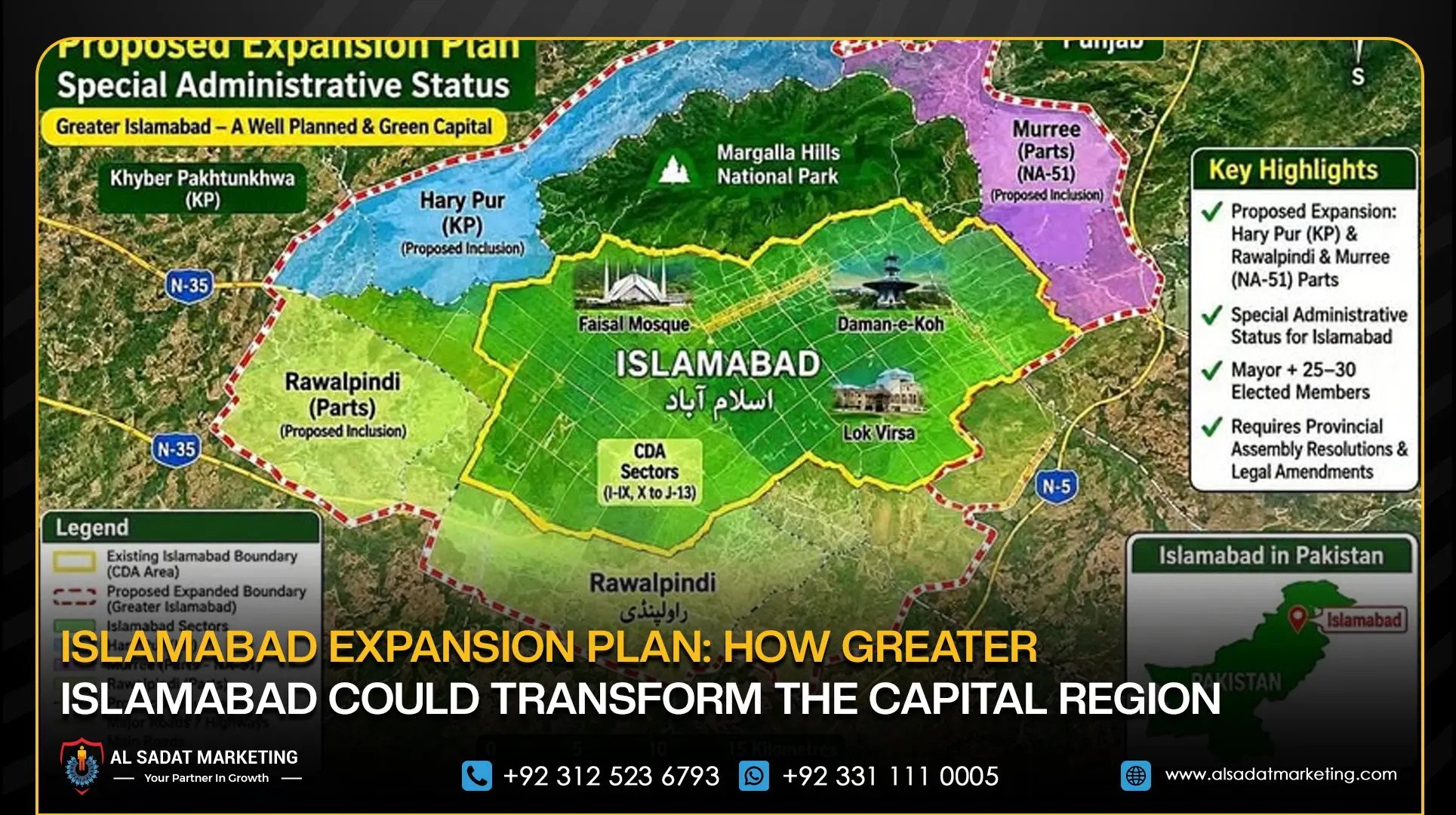
Under the proposal currently under consideration, parts of neighbouring Rawalpindi district, Haripur district in Khyber Pakhtunkhwa, and selected localities in Murree district could be incorporated into the federal capital’s jurisdiction.
The proposal is part of a broader vision to give Islamabad a special administrative status and develop it into a more integrated, efficiently governed metropolitan region.
According to reports published on November 15, 2026, the government is considering a new administrative model under which Islamabad’s mayor would serve as the head of the capital’s administration, supported by an elected governing body comprising approximately 25 to 30 members.
However, the proposed expansion and administrative changes have not yet received final approval.

Which Areas Could Become Part of Greater Islamabad?
The proposed expansion could extend Islamabad’s administrative boundaries beyond their existing limits to include selected areas from neighbouring districts.
The areas being considered include:
- Haripur, Khyber Pakhtunkhwa: Selected parts of Haripur district could be brought under Islamabad’s jurisdiction.
- Rawalpindi, Punjab: Certain localities in Rawalpindi district could become part of the expanded capital region.
- Murree, Punjab: Areas falling within National Assembly constituency NA-51 are also being considered.
If implemented, the proposal could create a more integrated metropolitan region connecting Islamabad with surrounding urban and semi-urban communities.
New Administrative Structure Proposed for Islamabad
Alongside geographical expansion, the federal government is considering a new governance system designed to give the capital greater administrative autonomy.
Under the proposed arrangement, the mayor would lead the administration, while an elected governing body of 25 to 30 members would oversee local affairs.
Earlier proposals also included a provincial-style governance framework featuring an elected Islamabad Capital Territory Assembly and a locally accountable chief executive.
The broader governance vision aims to improve coordination between government departments, strengthen municipal services, and make administrative decisions more responsive to residents.

How Greater Islamabad Could Transform the Capital Region
If approved and properly implemented, the proposed expansion could have significant implications for urban development, housing, transportation, and economic activity across the capital region.
1. Better Regional Connectivity
Bringing selected areas of Rawalpindi, Haripur, and Murree under a coordinated administrative framework could improve regional transport planning and connectivity.
Integrated road networks, improved public transportation, and better coordination between neighbouring communities could make daily travel easier for residents and commuters.
2. New Housing and Urban Development Opportunities
The expansion could create opportunities for planned residential development to accommodate Islamabad’s growing population.
New residential communities, commercial centres, and supporting infrastructure could help distribute population growth beyond the existing urban core.
However, any new development would require proper land-use planning, infrastructure investment, and environmental safeguards.

3. Greater Investment and Economic Activity
A larger metropolitan region could attract investment in commercial projects, business centres, tourism, education, healthcare, and other sectors.
Improved connectivity between Islamabad and surrounding districts could also create new employment opportunities and strengthen economic activity across the region.
4. Improved Public Services
A coordinated administrative structure could help improve the delivery of municipal services, including water supply, sanitation, waste management, healthcare, and public transportation.
Better coordination between neighbouring local administrations could also reduce overlapping responsibilities and improve service delivery.
5. New Opportunities for Tourism
Including selected areas around Haripur and Murree in a broader regional development framework could strengthen tourism planning and connectivity.
Improved infrastructure and coordinated tourism facilities could help attract more visitors while supporting businesses and employment in surrounding communities.
Islamabad’s Master Plan and Future Development
The proposed expansion comes at a time when Islamabad is facing increasing pressure from population growth, housing demand, and rapid urban development.
The capital’s existing master plan dates back to its original planning framework developed in 1960. Although several revisions and amendments have been introduced over the years, a comprehensive update remains a major planning challenge.
Urban planners and development authorities have repeatedly highlighted the need for a long-term strategy that addresses housing, transportation, environmental protection, and infrastructure requirements.
A broader metropolitan planning approach could help coordinate development across Islamabad and its neighbouring districts rather than allowing urban growth to take place through disconnected projects.
Final Decision Still Awaited
Despite the potential benefits, the Greater Islamabad expansion remains a proposal under consideration, and the government has not announced a final decision on the new boundaries or administrative arrangements.
Any changes would require further government approval, legal and administrative measures, and coordination with the affected provincial authorities and local communities.
If implemented with proper planning and sustainable development policies, Greater Islamabad could evolve into a more connected metropolitan region, creating new opportunities for housing, investment, tourism, and economic growth.
The success of the initiative, however, will depend on how effectively the government manages urban expansion while protecting local communities, public resources, and the natural environment.