
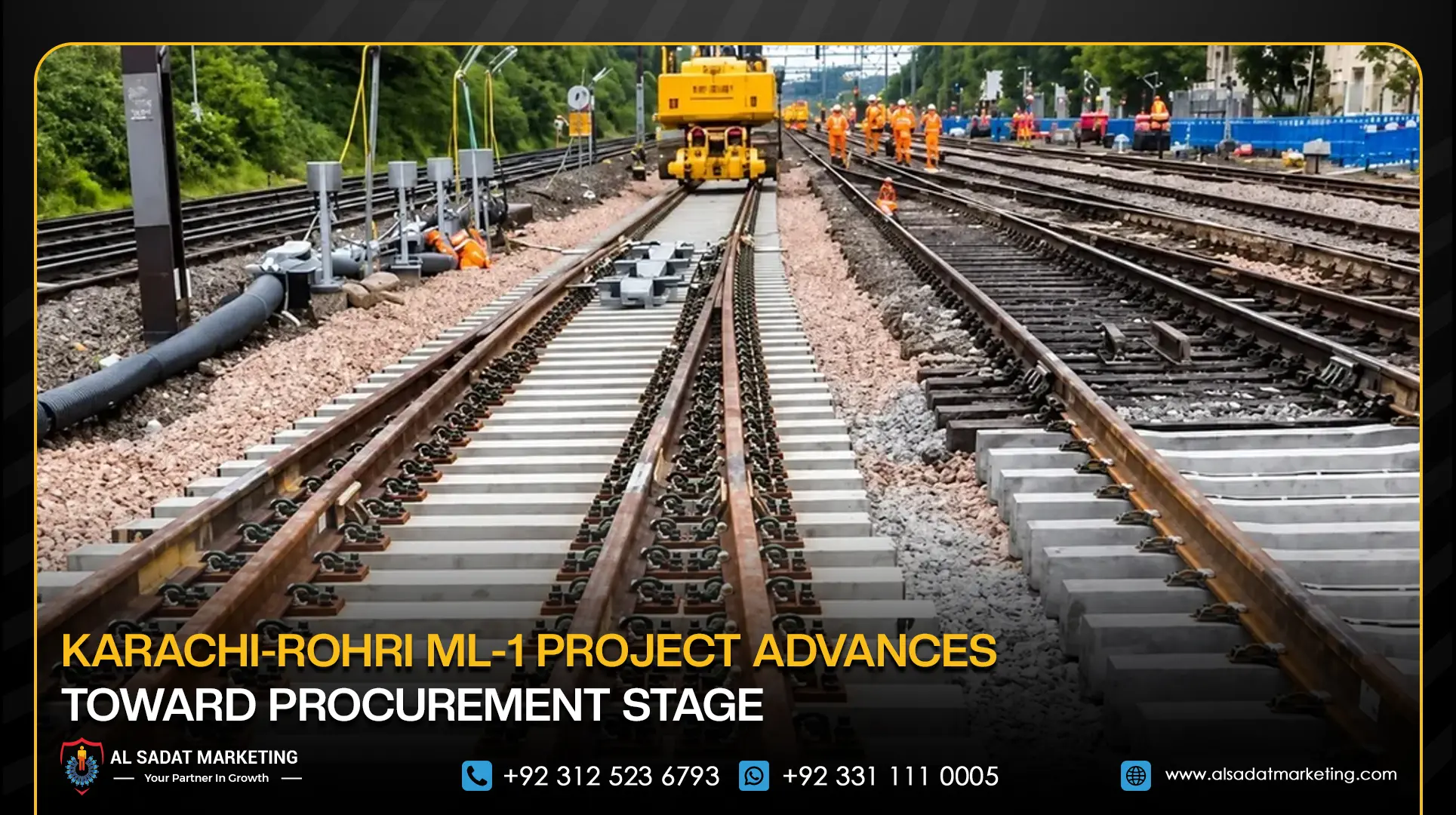
KARACHI: Pakistan Railways, with support from the Asian Development Bank (ADB), has completed a second pre-market consultation for the Karachi-Rohri section of the Main Line-1 (ML-1) railway upgrade project, bringing the long-discussed initiative closer to its formal procurement phase.
The consultation attracted 134 participants, including local and international contractors, consultants, equipment suppliers and manufacturers. Feedback from the session will be used to help refine the project’s procurement approach.
Financing Plan Moves Forward
Pakistan is also seeking approximately $2.5 billion in financing from an international lender consortium for the Karachi-Rohri section.
The ADB is expected to play a leading role in the financing arrangement, potentially contributing more than $1 billion. Other institutions, including the Asian Infrastructure Investment Bank (AIIB) and the World Bank, are also expected to participate.
The financing is planned to be arranged in multiple tranches rather than through a single disbursement. ADB technical teams and project consultants are working toward completing the project design in October 2026, after which procurement and implementation activities are expected to progress.

Consultation Is Not the Same as Financing Approval
The latest market consultation represents an important procurement-preparation milestone, but it does not mean that the project’s full financing has already been secured.
Market consultations allow contractors, suppliers and other industry participants to provide input on issues such as procurement arrangements, technical requirements and project risks. Formal financing approval and completion of procurement procedures remain necessary before physical construction can begin.
Scope Covers 480 Kilometres of Railway
According to ADB project documentation, the proposed investment covers approximately 480 kilometres between Karachi and Rohri, one of Pakistan Railways’ most important passenger and freight corridors.
The planned improvements include track reconstruction, selected realignments, bridges and culverts, station upgrades, freight-yard improvements and upgrades to railway buildings. The project also includes modernisation of signalling and telecommunications, along with institutional and capacity-building measures.
The corridor includes the Keamari-Landhi-Hyderabad, Hyderabad-Nawabshah and Nawabshah-Rohri sections.
Corridor Carries Major Freight and Passenger Traffic
The Karachi-Rohri route has been prioritised because of its importance to Pakistan’s railway network. The corridor reportedly handles around 76 percent of passenger traffic and 98 percent of freight traffic across the network.
Upgrading the route is therefore intended to improve railway capacity, operational efficiency, safety and connectivity along a major national transport corridor.
The project also reflects a broader effort to strengthen rail infrastructure after years of comparatively greater investment in road transportation.

Procurement Process Has Multiple Stages
The latest consultation follows an earlier General Procurement Notice and Early Market Engagement exercise conducted for the ADB-supported component.
The successive market-engagement activities are intended to help authorities better understand contractor capacity, potential risk allocation and the practical challenges involved in upgrading an active railway corridor while services continue to operate.
The consultation also considered opportunities for local industry participation and the use of climate-resilient and digital technologies.
Construction Start Still Depends on Remaining Steps
The government has indicated an intention to begin work on the Karachi-Rohri section during the current financial year, with construction expected to take approximately two to three years once formally started.
However, several milestones remain before physical work can begin. These include formal financing approval, finalisation of the procurement strategy, completion of project preparation and subsequent procurement procedures.

Potential Impact on Logistics and Industrial Activity
Modernisation of the Karachi-Rohri railway corridor could have implications for freight movement, logistics and industrial activity along the route.
Improved rail capacity and reliability could benefit businesses involved in manufacturing, warehousing and bulk freight transportation, particularly in areas connected to the Karachi, Hyderabad, Nawabshah and Rohri sections.
For investors considering industrial or logistics property along the corridor, however, formal financing approval and the start of construction will be more significant indicators than the consultation stage alone. The latest development shows that the project is progressing through preparation and procurement, but physical implementation still depends on the remaining approvals and financing milestones.