
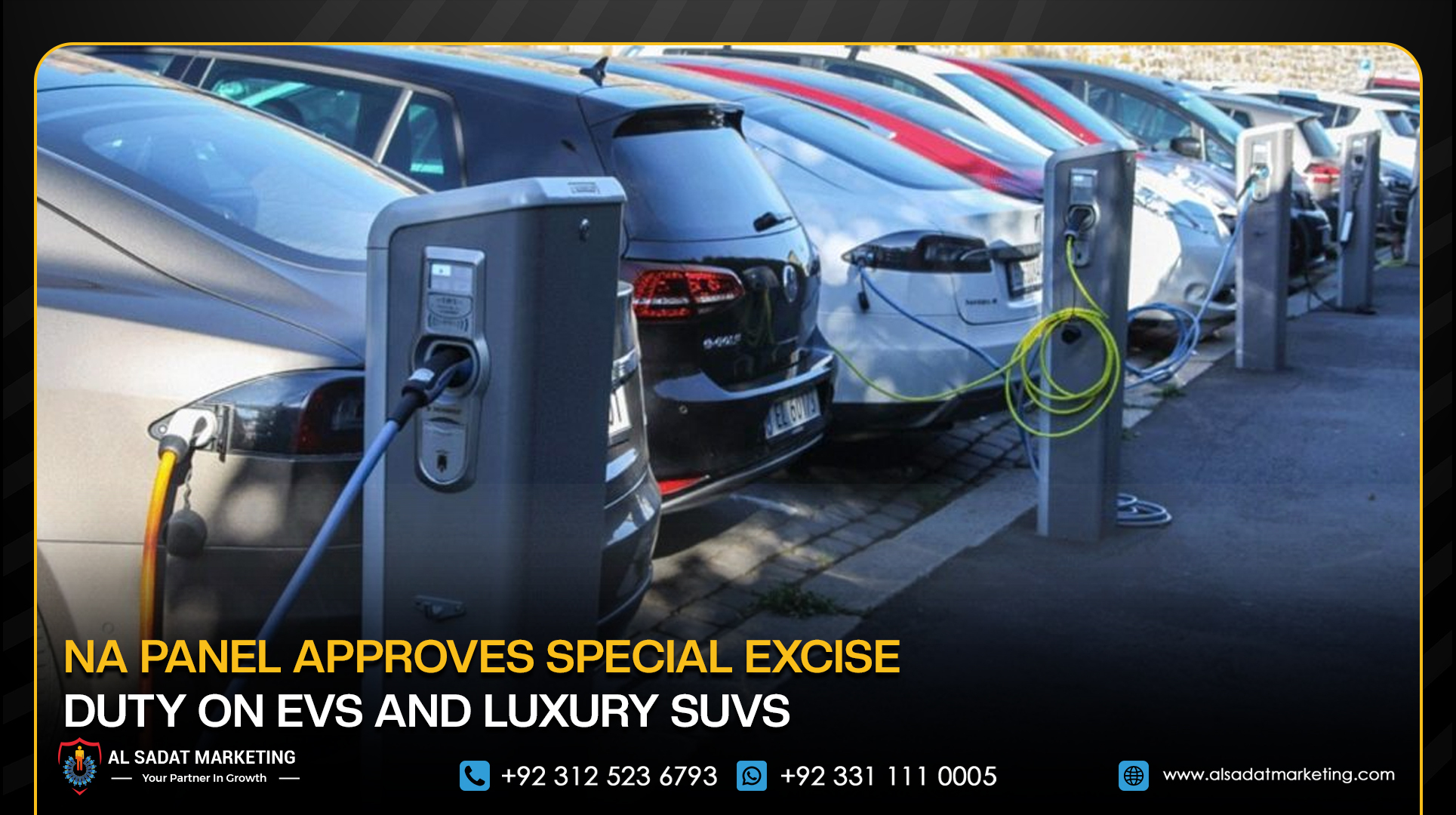
The National Assembly Standing Committee on Finance and Revenue has approved the imposition of a special excise duty on electric vehicles (EVs) and luxury sports utility vehicles (SUVs), based on their dollar value, as it finalized recommendations on the Finance Bill 2026-27 ahead of its passage in the lower house.
The committee presented a 15-page report containing multiple amendments to the finance bill. These include proposals related to imported vehicles, minimum taxation on various consumer goods, taxation measures for the steel sector, mobile phone import payments, and enhanced data-sharing mechanisms aimed at identifying potential tax evasion.
The National Assembly is scheduled to take up the Finance Bill 2026-27 for approval. The government has informed both the IMF and lawmakers that 26 additional measures—including policy changes, enforcement actions, and revised tax rates—are expected to generate approximately Rs. 1,020 billion in revenue for the Federal Board of Revenue (FBR) in the upcoming fiscal year.
The FBR has been assigned a revenue target of Rs. 15.264 trillion for 2026-27, compared to a revised target of Rs. 12.983 trillion for the current fiscal year ending June 30, 2026.
Under the approved proposals, imported electric vehicles in completely built-up condition valued up to $75,000 will remain exempt from the new duty. Vehicles priced between $75,000 and $110,000 will be subject to a 30% ad valorem tax, while those exceeding $110,000 will face a 40% tax.
For imported petrol and diesel vehicles, including SUVs and passenger cars with engine capacities between 2,000cc and 3,000cc, an 86% ad valorem tax has been proposed. Vehicles above 3,000cc will be taxed at 9%.
The government has also proposed reducing regulatory duties on imported vehicles while offsetting the revenue impact through the new excise structure. However, the move has raised concerns among local auto manufacturers and parts suppliers, who argue that the upcoming auto policy has been significantly diluted.
The committee also approved a 0.5% minimum tax under Section 113 for distributors, dealers, sub-dealers, and wholesalers across 14 major product categories, including pharmaceuticals, fertilizer, cigarettes, sugar, food products, electronics, beverages, cosmetics, household goods, and other consumer items.
A 5% withholding tax on income generated from social media platforms was also approved.
For the steel sector, a new taxation mechanism was finalized under which tax will be collected based on electricity consumption per unit, including usage from captive and alternative energy sources. The tax will be adjustable against input tax in monthly returns, with provisions for reduced rates for compliant and digitally integrated units.
The committee also approved exemptions for aircraft imported by PIACL, while allowing tax exemptions on aircraft imports or leases by registered Pakistani airlines effective from July 1, 2027.
Additionally, individuals importing mobile phones will be allowed to pay taxes in instalments through the PTA’s device identification system, provided all dues are cleared within the same financial year.
A 3% value addition tax on imports by manufacturers was also approved, along with a minimum 1% tax on coal imports supplied directly to independent power producers.
To strengthen tax enforcement, the committee approved the establishment of a centralized banking data repository under the State Bank of Pakistan. This system will allow secure data sharing with the FBR to identify potential tax evaders.
Penalties for non-compliance include Rs. 500,000 for the first violation and Rs. 1 million for subsequent defaults by responsible officers or business owners.