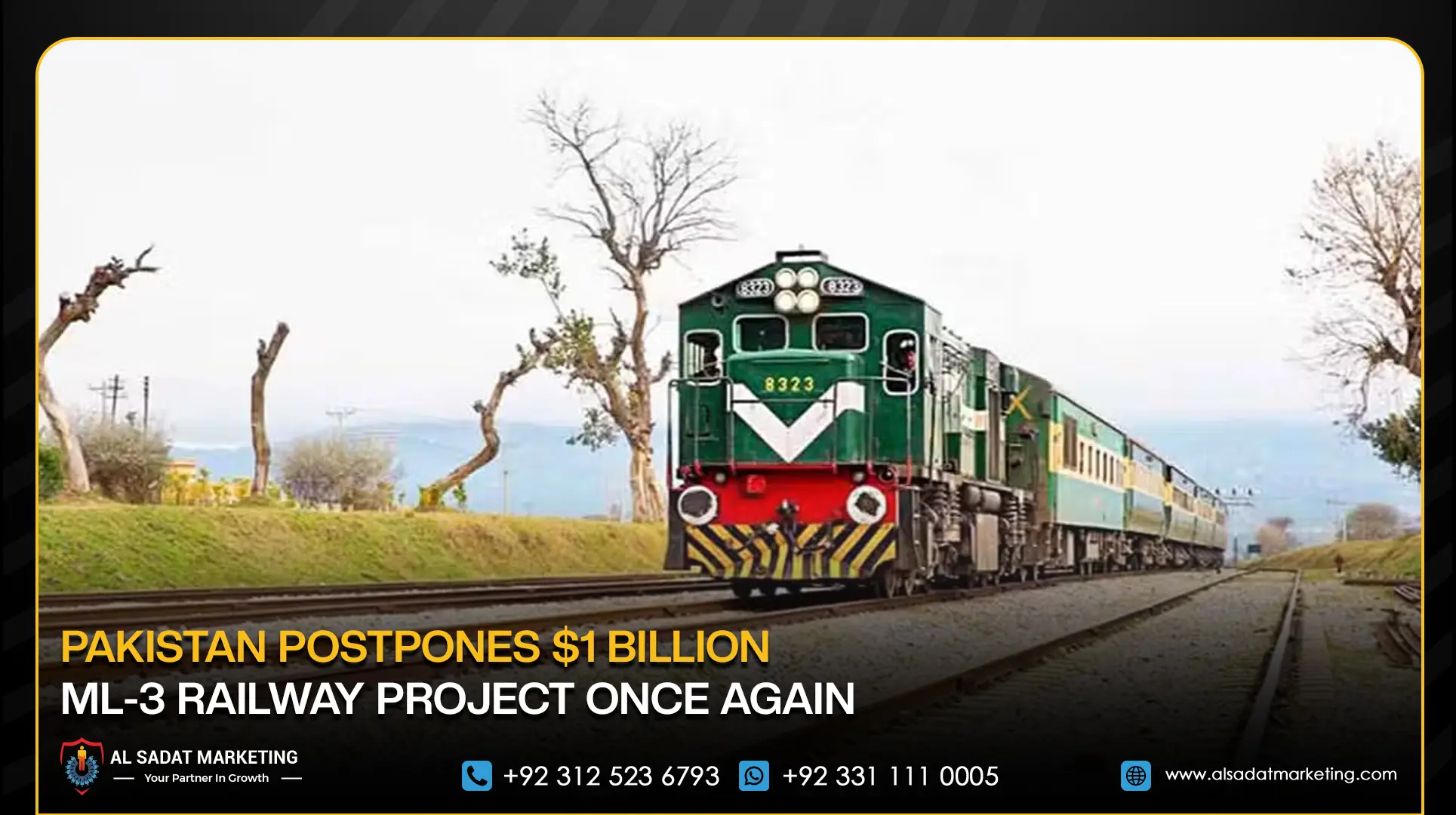
In order to clarify financial arrangements and reconsider the proposed export route for minerals from the Reko Diq project, Pakistan has postponed authorizing the $1 billion Main Line-3 (ML-3) railroad maintenance project for the third time in five months.
The Central Development Working Party (CDWP) again postponed the Rs278 billion project this month. The project aims to rebuild the railroad line between Nokhandi and Rohri in order to facilitate large mineral traffic.
ML-3 Railway Infrastructure Requires Major Upgrades
The projected rehabilitation includes around 996 kilometers of train infrastructure. The current track has outlived its usable life, with trains reportedly traveling at an average speed of roughly 30 kilometers per hour.
The government feels that the development is necessary to enable the transportation of heavy mineral cargo from the Reko Diq copper and gold output.
Planning Minister Ahsan Iqbal stated that the need for additional information about a possible bridge-financing arrangement with Reko Diq Mining Company was the reason for the most recent delay.

$390 Million Financing Arrangement Under Review
To fund the railroad project, the government earlier gave Reko Diq Mining Company a $390 million bridge loan.
With an estimated 6% annual interest rate, the planned financing would be paid back in full by June 2028. Depending on the agreed-upon rate, the ultimate payments might total roughly $450 million.
However, the arrangement has come under investigation due to discussions of moving the mineral export route from Karachi Port to Gwadar Port. Officials want to know if the mining company will continue to give funds if the planned transportation route is changed.
Gwadar Being Considered as an Alternative Export Route
The original plan envisaged using the Nokhandi-Quetta-Rohri train track to transport minerals from Reko Diq to Karachi.
Authorities are currently looking into Gwadar as a possible export destination. Pursuing this option would require the Nokhandi-Panjgur-Gwadar road connection to be completely operational.
The problem has increased along with interest in Pakistan’s mining sector. Minmetals, Ivanhoe Atlantic, and Barrick Gold executives attended the Pakistan Minerals Investment Forum.
A delegation from Barrick also met with Planning Minister Ahsan Iqbal to discuss the proposed road corridor. In order to accelerate the development of the Nokundi-Gwadar route, the minister called for cooperation between the federal and Balochistan governments as well as mining companies.
He also recommended that a cooperative working committee be established by the Planning Ministry, the National Highway Authority, the Balochistani administration, and mining companies. The group would examine technical requirements, finance, viability, and implementation strategies.
Repeated Delays Raise Questions About Project Financing
The CDWP has already reviewed the ML-3 project in June and August. During an earlier assessment, the Ministry of Railroads was asked to submit a unified analysis of its financial requirements for the next five years.
The plan was expected to identify funds from Pakistan Railroads’ own resources, the Public Sector Development Program (PSDP), and other financing sources.
The Rs278.62 billion plan had already received in-principle clearance from the Planning Ministry, which also suggested that it be given more thought. Its range consists of:
- Renewal and rehabilitation of railway tracks
- Repair of bridges and embankments
- Replacement of railway turnouts
- Construction of 11 new railway stations between Spezand and Taftan
The Planning Commission also expressed concerns about the project documents, pointing out that there was insufficient explanation of the level of coordination and engagement with Reko Diq Mining Company.
Just Rs250 million has been allocated for the project for the current fiscal year. The committee warned that insufficient funding could result in more delays and increase the overall cost, drawing attention to cost overruns in previous railroad projects.
Ahsan Iqbal also questioned Pakistan Railroads’ ability to finance the project, arguing that PSDP financing was insufficient to cover the entire cost. He instructed the Railroads Ministry to develop a five-year budget that would cover ML-3, ML-2, and ML-1.
Additionally, the minister recommended that the department align development initiatives with available money. The current development portfolio of Pakistan Railroads is reportedly valued at approximately Rs40 billion.

ML-3 Could Strengthen Regional Freight Connectivity
The Quetta-Taftan railroad stretch, which is part of Pakistan’s transportation network with Iran and Turkiye, supports both passenger and freight services.
However, because of the track’s deteriorating condition, activities have been restricted. There are reportedly just one or two freight trains operating each month between Quetta and Taftan.
Renovations are expected to increase freight capacity and railroad traffic, according to the government. In addition to other cargo services to Iran and its neighbors, the refurbished route may eventually be able to accommodate up to eight sets of freight trains, according to officials.
Possibilities to strengthen Pakistan Better operations may also increase freight revenue for railroads.
ML-1 Funding Challenges Add to Railway Sector Pressures
ML-3 is facing financial difficulties because the government is still trying to find methods to fund the bigger ML-1 Karachi-Peshawar train project.
Proposals under consideration include the use of Pakistan Railroads’ land as security to obtain money from domestic commercial banks, a possible loan from the Asian Development Bank, and a lease arrangement led by the Frontier Works Organization.
Meanwhile, the Pakistan Minerals Investment Forum also discussed ways to increase the value of Pakistan’s mineral exports. Prime Minister Shehbaz Sharif and Chief of Defense Forces Field Marshal Syed Asim Munir stressed the importance of developing local processing capacity and exporting finished mineral items rather than relying primarily on the sale of raw materials.
ML-3’s future will depend on how its finance problems are resolved and which transportation route is best for Reko Diq minerals. Until these problems are fixed, the project is still subject to review and approval.