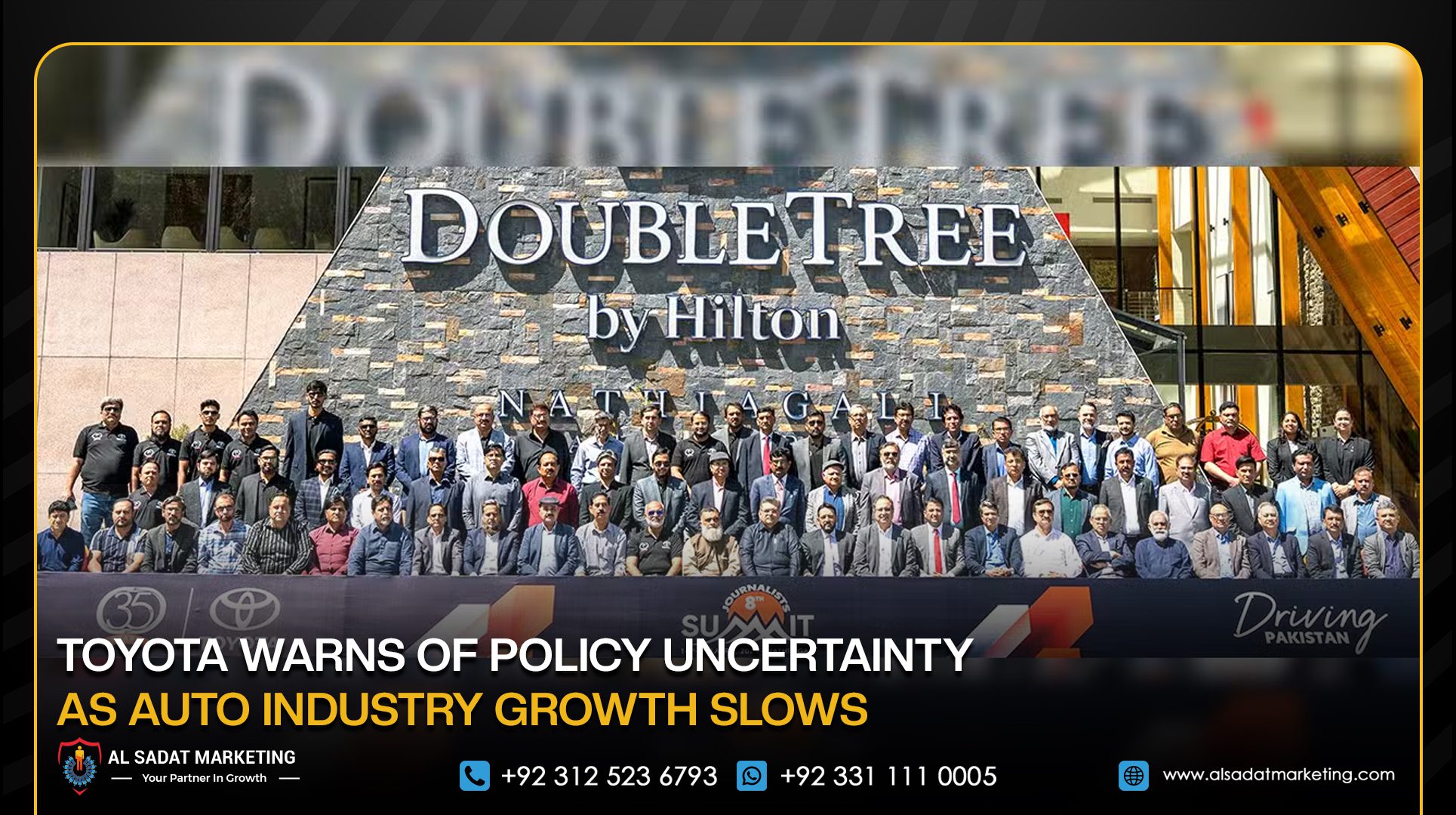
Pakistan’s automotive sector continues to face structural challenges, including policy inconsistency, low capacity utilization, and growing reliance on used car imports, despite its long-term growth potential in the regional market. These issues were highlighted during an industry engagement hosted by Indus Motor Company, where company executives briefed media representatives on market trends and policy direction.
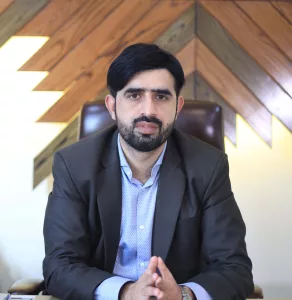
During the session, Indus Motor Company Chief Executive Officer Ali Asghar Jamali shared an overview of Pakistan’s automotive performance compared with regional peers. He noted that Pakistan is among only 16 countries globally capable of producing passenger cars, light commercial vehicles, trucks, and buses, and that seven of the world’s top ten automotive brands operate in the country, reflecting its potential as an investment destination.
Comparing regional growth trends, Jamali said that over the past decade India’s automotive market expanded by 60 percent, while the Philippines and Vietnam grew by 71 percent and 180 percent respectively. In contrast, Pakistan recorded growth of just 15 percent, which he attributed to policy inconsistency, frequent regulatory changes, and rising used car imports.
He added that the automotive sector contributes around 2.8 percent to Pakistan’s GDP and provides employment to approximately 1.8 million people. Despite the presence of 31 global brands, capacity utilization remains around 30 percent of the installed 600,000-unit annual production capacity, down from 84 percent in 2017–18.
Jamali identified used car imports, policy instability, and a complex taxation regime as key factors behind underutilization. He welcomed recent policy steps, including the abolition of the baggage scheme for used car imports, calling it a positive move for strengthening local manufacturing and boosting demand for locally assembled vehicles.
On foreign exchange impact, the company stated that local vehicle assembly accounts for just 2.08 percent of total imports, while imports of completely built-up (CBU) vehicles have increased from 0.03 percent in 2023 to 0.78 percent in 2026. It also noted that the automotive sector’s share in import bills is significantly higher in countries such as the United States, United Kingdom, Germany, Japan, China, and India.
Jamali emphasized the need for a stable, long-term automotive policy framework for 2026–31 with minimal revisions to support localization and investor confidence. He said Indus Motor Company would align its future strategy with the government’s upcoming policy direction.
He also highlighted Toyota’s long-standing presence in Pakistan, including $736 million in investments over the past 35 years, with an additional $300 million planned over the next five years. The company has contributed $6.3 billion in taxes and helped save an estimated $6.5 billion in foreign exchange through localization.
Indus Motor’s ecosystem, including dealerships and suppliers, supports over 55,000 jobs. Its manufacturing facility follows Toyota global standards and has been recognized as a “Zero Defect Facility” among Asian plants. The company also operates a major sheet metal parts plant, a 6.6-megawatt rooftop solar system, and CSR programs that reached over 200,000 beneficiaries last year.
Concluding the briefing, Jamali stressed that consistent policy, improved financing mechanisms, and stronger localization efforts are essential to improving capacity utilization and positioning Pakistan’s auto sector for sustainable growth.