
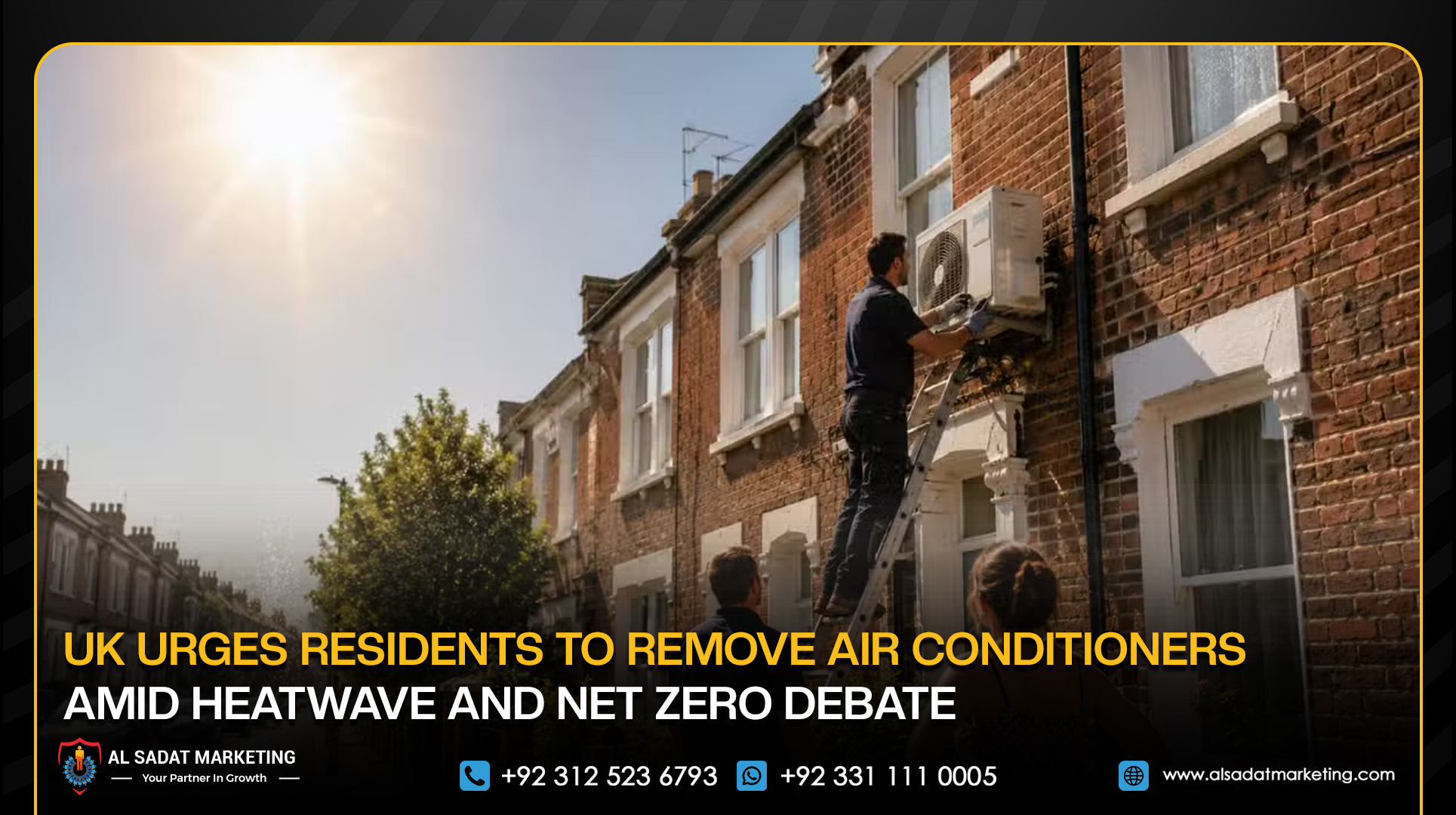
Several homeowners in the United Kingdom have been instructed to remove air-conditioning units installed on their properties, sparking debate over planning regulations as the country faces increasingly frequent and intense summer heatwaves.
The enforcement actions primarily involve fixed outdoor air-conditioning systems that were installed without meeting local planning requirements. While a number of reported cases have emerged from the London Borough of Camden, the UK government has clarified that there is no nationwide ban on residential air conditioning.
Officials have emphasized that homeowners are free to install cooling systems in both new and existing properties, although some fixed installations may require planning permission depending on their design, location, and potential impact on surrounding properties.
Camden Planning Disputes
One of the reported cases involved a homeowner in Camden who was ordered to remove two air-conditioning units installed at the rear of a residential property after planning officials determined there was insufficient justification for the installation.
In another case, three outdoor units installed on the roof of a four-storey building became the subject of an enforcement notice issued in December 2024. The notice required the homeowner to remove the equipment, clear construction debris, and restore the affected area.
The homeowner appealed the decision, and in February 2026 a planning inspector overturned the enforcement order. The inspector concluded that the units had no significant visual impact on the property and accepted evidence showing that noise levels remained within acceptable limits. The ruling also acknowledged that passive cooling methods alone may not adequately cool some existing buildings.
Why Planning Permission Is Sometimes Required
Planning authorities in London follow a “cooling hierarchy,” which encourages homeowners and developers to prioritize energy-efficient methods of reducing indoor temperatures before installing conventional air-conditioning systems.
These measures include:
- External shading
- Improved insulation
- High-performance glazing
- Building orientation
- Natural ventilation
- Mechanical ventilation systems
Traditional air conditioning is generally viewed as a last resort, and applicants may need to demonstrate that passive cooling techniques cannot maintain safe or comfortable indoor temperatures.
The policy is intended to reduce electricity consumption, lower carbon emissions, and limit the urban heat island effect, where densely built-up areas become significantly warmer than surrounding regions due to waste heat generated by buildings and cooling equipment.
Camden Council has stated that enforcement action is used only in limited circumstances and is considered a last resort. Planning requirements may also be stricter for listed buildings, conservation areas, and apartment developments.
Government Clarifies There Is No Air Conditioning Ban
The UK government has rejected claims suggesting that residential air conditioning has been prohibited across the country.
Officials confirmed that homeowners can install cooling systems, but planning approval may be necessary for fixed outdoor units depending on factors such as their appearance, noise levels, and impact on neighboring properties.
Similarly, London City Hall has said its planning policies do not ban air conditioning. Instead, developers are encouraged to first consider less energy-intensive cooling solutions before relying on mechanical systems.
Rising Demand for Home Cooling
Demand for residential air conditioning has grown rapidly as the UK experiences hotter summers and more people continue working from home.
Industry estimates suggest that around four million homes across the UK now use some form of air conditioning—approximately double the number recorded three years ago.
Of these, about 1.9 million households have permanent built-in systems, while roughly 2.2 million rely on portable air conditioners.
Although these systems provide relief during heatwaves, they can also increase electricity consumption and household energy bills, particularly during extended periods of high temperatures.
Energy experts note that air-to-air heat pumps offer a more efficient alternative, providing both heating and cooling while consuming less electricity than many traditional air-conditioning units. When combined with solar panels, these systems can further reduce operating costs and carbon emissions.
Climate Experts Call for Greater Adaptation
The debate follows a recent warning from the UK’s Climate Change Committee, which concluded that passive cooling measures alone will not be sufficient to protect many homes from rising temperatures.
The committee estimates that around 22 percent of the UK’s housing stock could require active cooling solutions under a future scenario involving two degrees of global warming.
Potential options include air conditioners, reversible heat pumps, and portable cooling units. The committee also noted that expanding solar energy generation and battery storage could help meet higher electricity demand during heatwaves with relatively low carbon emissions.
As extreme heat becomes more common, policymakers face the challenge of balancing energy efficiency goals with the need to protect public health.
The recent planning disputes do not represent a nationwide ban on domestic air conditioning. Instead, they highlight how individual installations may face enforcement if they fail to comply with local planning regulations relating to building design, noise, or environmental considerations.