
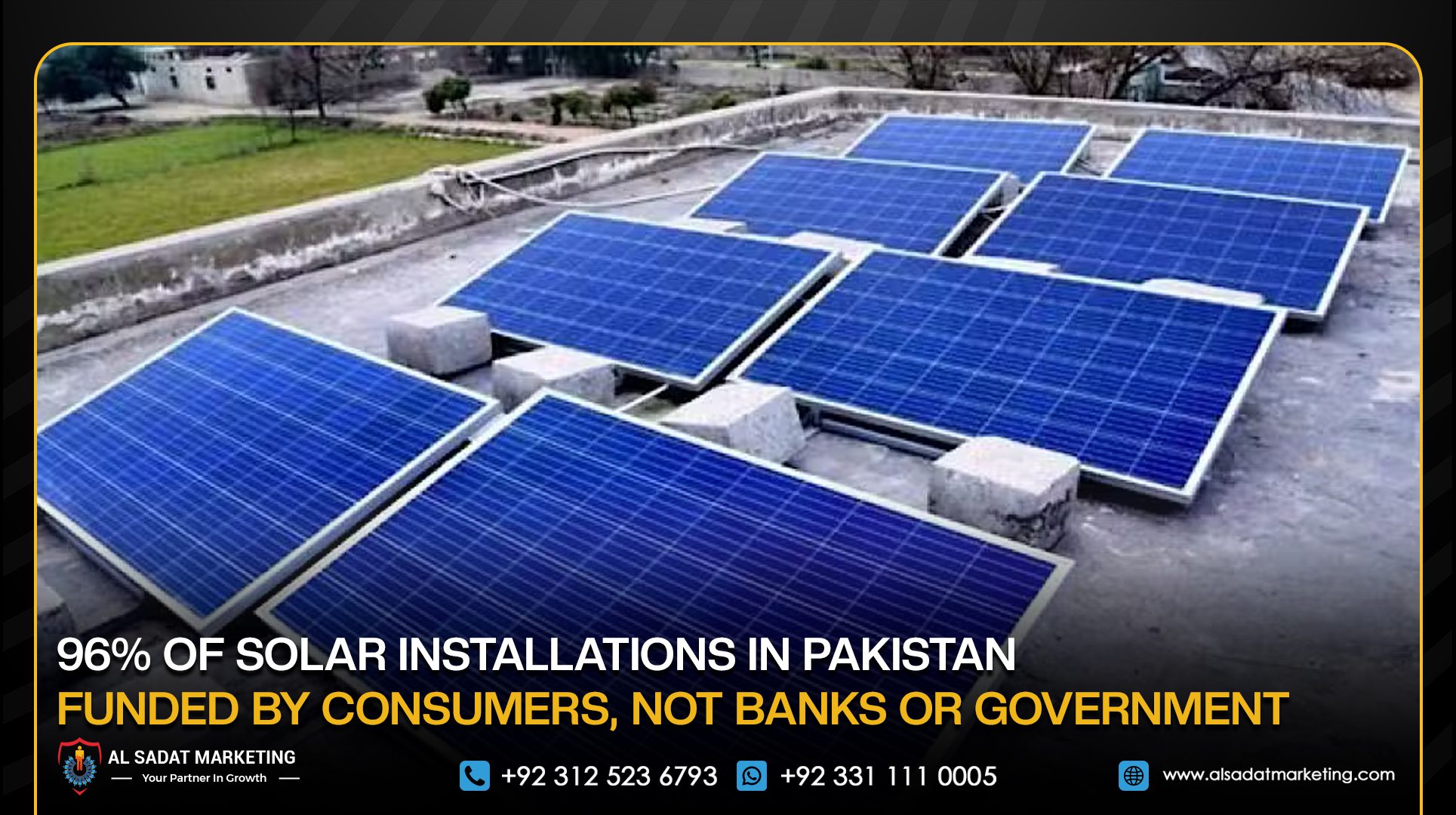
A new report has revealed that the vast majority of Pakistan’s rapidly growing solar energy adoption has been financed directly by consumers rather than through banks or government-backed lending programs.
The study, titled Customer Owned Renewable Electrification (CORE) Finance Mapping, was launched by Renewables First and provides a comprehensive overview of distributed solar financing trends in the country.
According to the report, formal bank financing accounts for only 3.4% of the estimated $14 billion invested in distributed solar systems across Pakistan so far. The remaining investment has largely been self-financed by households, businesses, and farmers.
The report states that Pakistan’s distributed solar capacity reached 38 GW in FY2025, driven mainly by rising electricity tariffs and inflation, which have made solar energy a more affordable alternative for consumers.
Of the total installed solar capacity:
- 21.3 GW operates behind the meter
- 9.7 GW is off-grid
- 7.3 GW is net-metered
The residential sector remains the largest contributor to solar adoption, followed by industrial, agricultural, and commercial users.
Residential Sector Leads Adoption
More than 7.3 million households in Pakistan have adopted solar systems. However, financing penetration in the residential sector remains below 1%, making it the least financed segment despite strong demand.
The report notes that alternative financing models such as retailer installment plans and Buy Now Pay Later (BNPL) services have partially filled the gap left by traditional banks.
Rapid Solarization in Agriculture
Pakistan’s agricultural sector has also seen major growth in solar adoption, with nearly one million tubewells converted to solar power.
Solar’s share in the agricultural tubewell energy mix surged from almost zero to 61% between 2022 and 2025, helping reduce reliance on expensive diesel fuel, which previously made up a significant portion of farming costs.
Although agricultural solar financing is supported by microfinance institutions, government subsidies, and priority lending schemes from the State Bank of Pakistan, formal financing still represents only 3.1% of agri-solar investments.
Industrial Financing Still Limited
The report found that formal financing in the commercial and industrial solar sector remains concentrated among large businesses with strong credit profiles. Smaller businesses continue to rely mostly on cash payments or informal retailer financing.
Industrial solar financing penetration stands at 9.3%, while commercial sector financing remains at 4.8%.
Experts Call for Structured Financing
Ahtasam Ahmad stated that distributed solar systems do not fit traditional banking models due to smaller loan sizes, high transaction costs, and lending systems that fail to account for energy savings as a repayment source.
The report estimates that Pakistan’s distributed solar deployment helped avoid nearly 46 million tonnes of CO₂-equivalent emissions during FY2025.
Experts warn that future growth in Pakistan’s clean energy transition will depend heavily on the availability of structured financing solutions. Without improved financial access, households, farmers, and small businesses may struggle to adopt solar technology at a larger scale.