For the first time in more than a decade, residents of Islamabad could soon gain a direct role in how the capital is governed, under a major reform proposal aimed at transforming the city into a modern, citizen-led and sustainable urban model.
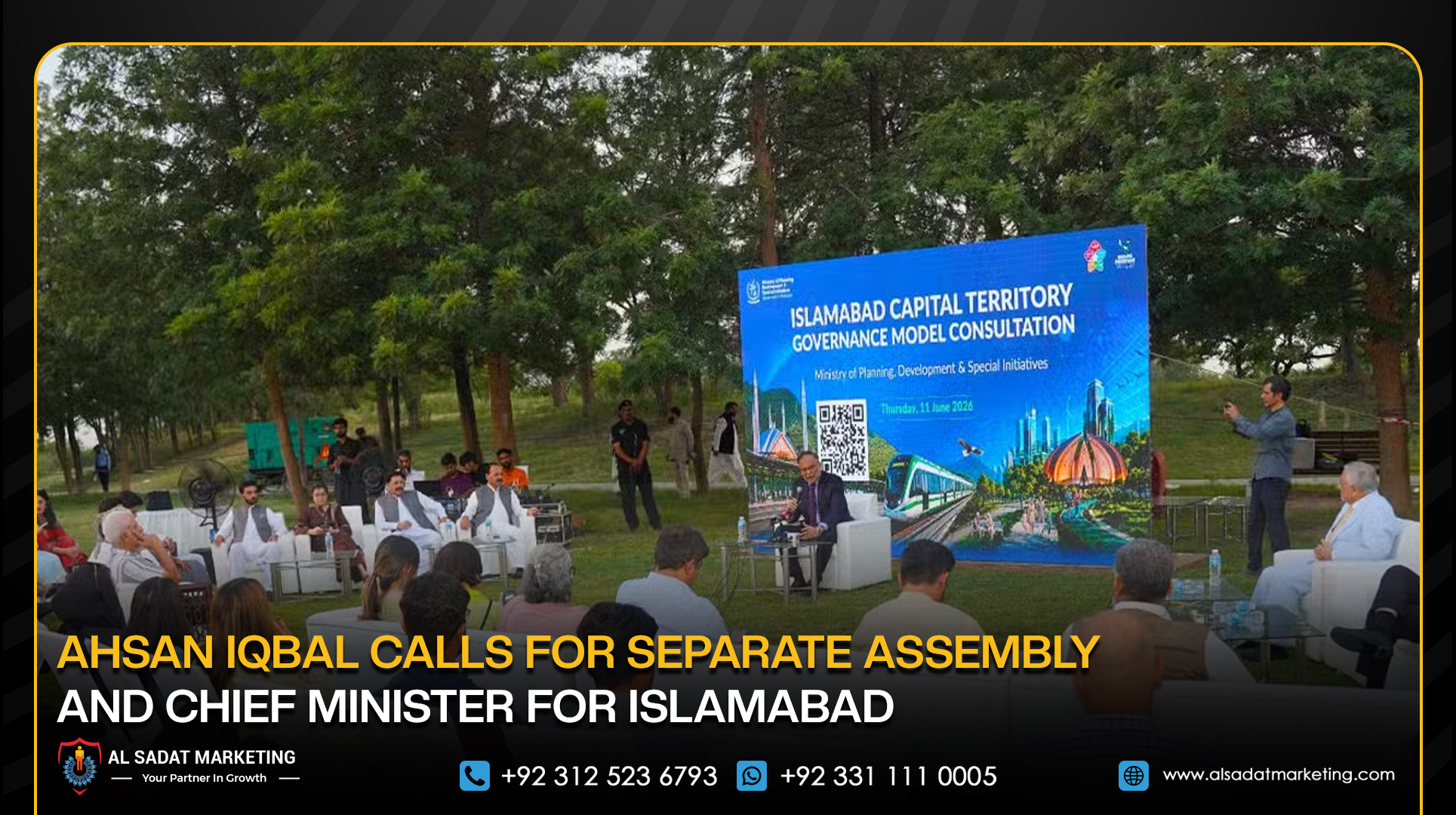
Federal Minister for Planning, Development and Special Initiatives Prof. Ahsan Iqbal shared details of the proposed Islamabad Capital Territory (ICT) Governance Model during a public consultation held at Fatima Jinnah Park. The plan envisions reshaping Islamabad into a globally competitive capital with stronger public participation, improved service delivery, and greater administrative efficiency.
Elected Assembly Proposed for Islamabad
At the core of the proposal is the creation of a 27-member Islamabad Capital Territory Assembly, consisting of 21 directly elected members, five reserved seats for women, and one for minorities. The assembly would elect its own chief executive—either a Chief Minister or Mayor—who would oversee local governance.
Under the proposed framework, the ICT government would function with administrative and financial autonomy similar to a provincial setup. Key public sectors including health, education, environment, and municipal services would be transferred to the elected local government.
Prof. Ahsan Iqbal said Islamabad must evolve beyond its traditional administrative structure. “The city has expanded significantly and now requires a governance system that is democratic, accountable, and citizen-centered,” he said.
Shift Toward Citizen-Centered Governance
The minister emphasized that Islamabad, with a population exceeding 2.4 million, has outgrown its existing governance model, which was originally designed for a much smaller administrative setup. He noted that meaningful local representation had last been seen in 2015 and said reform is now necessary to address growing urban challenges.
“The capital must reflect the aspirations of its people and become a model of good governance, sustainability, and innovation,” he said.
Federal Control and Institutional Structure
While proposing decentralization, the plan retains federal control over law and order and master planning, given Islamabad’s status as the national capital.
To improve service delivery, the proposal also includes the creation of six specialized authorities:
- ICT Health Authority
- ICT Education Authority
- Social Welfare and Inclusion Authority
- Tourism and Culture Authority
- Environment and Climate Authority
- Digital and E-Governance Authority
Each body would focus on improving efficiency and professional management in key public sectors.
“SMART City” Vision for Islamabad
The reform package also introduces a SMART City framework—Sustainable, Modern, Accessible, Resilient, and Technology-driven. It aims to integrate digital systems, data-based governance, and smart infrastructure to enhance urban management.
Officials said technology would be used to address real civic challenges such as traffic management, waste disposal, public health, and citizen feedback systems.
“A smart city is not defined by technology alone, but by how effectively it improves citizens’ lives,” Prof. Iqbal said.
Public Consultation and Next Steps
The proposal has been developed following a high-level committee formed by Prime Minister Shehbaz Sharif to review Islamabad’s governance structure. Unusually, the draft report has been shared publicly to gather feedback from citizens, experts, and civil society before any final decision is made.
The consultation session brought together lawmakers, urban planners, academics, legal experts, and citizens, many of whom supported the direction of reforms while calling for a clear electoral timeline, stronger devolution of powers, and safeguards against administrative overlap.
Participants also emphasized preserving Islamabad’s green character, improving municipal services, and ensuring representation for all communities, including rural areas within the ICT.
Prof. Iqbal assured that public input would be incorporated into the final recommendations before submission to the federal government.
“Lasting reform requires public trust and collective ownership,” he said. “Islamabad’s future must be shaped by the people who live and invest their hopes in this city.”
A Potential Turning Point for the Capital
If approved, the proposed reforms would represent one of the most significant changes in Islamabad’s governance history—shifting the capital from a centrally administered territory toward a more democratic and locally accountable urban government.
The plan signals an ambition to position Islamabad not only as Pakistan’s administrative center but also as a model city for 21st-century urban governance.