
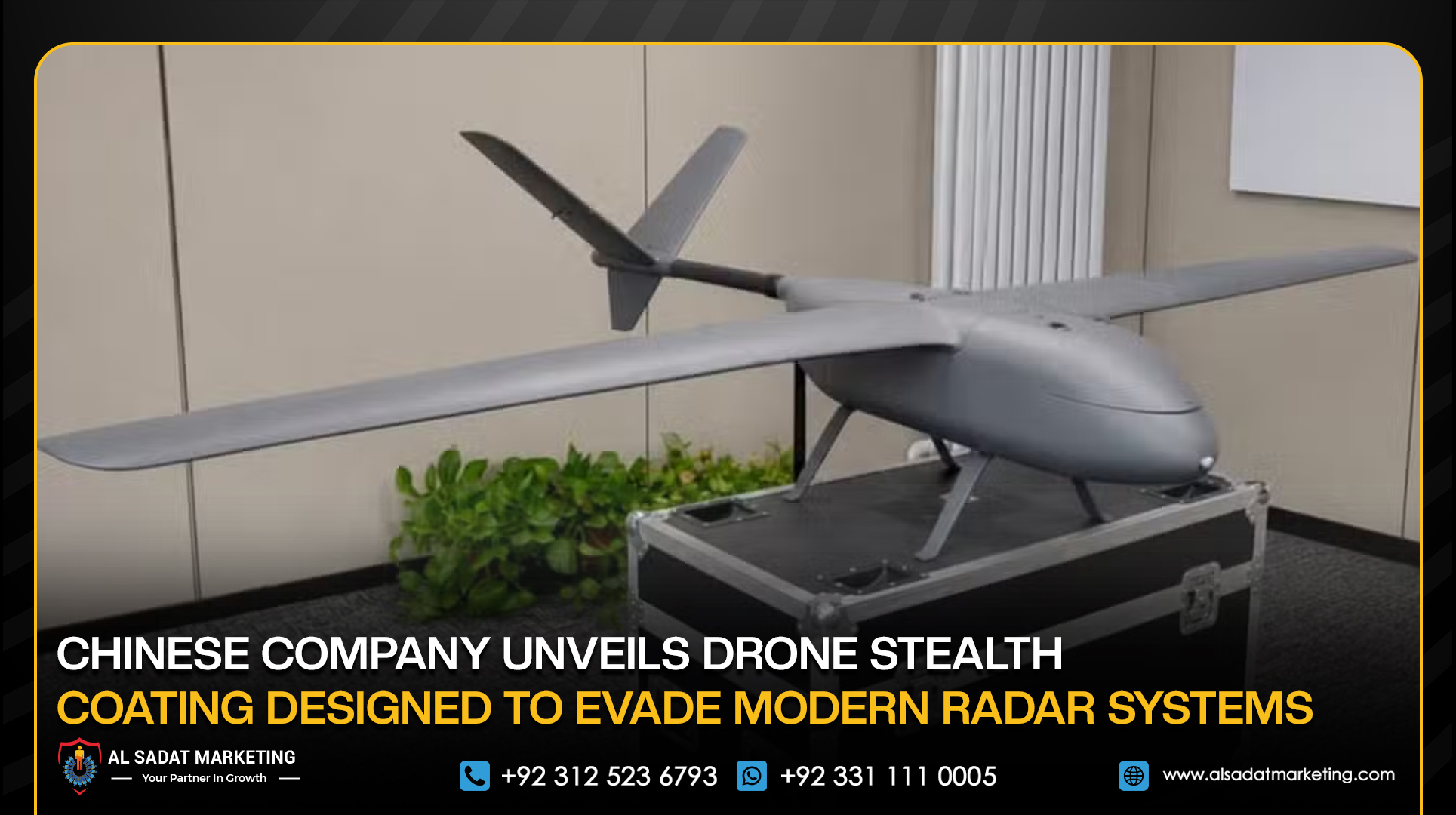
A technology company based in Shenzhen, China, is marketing a new radar-absorbing coating designed to make drones and other platforms more difficult to detect by radar systems.
The company, Star Navi, is offering the product through its XRAM C series, which is designed to reduce the radar signature of drones, aircraft, and naval platforms. The coating is available in multiple package sizes and can be applied using specialized spray equipment.
Growing Challenge for Counter-Drone Systems
As drones play an increasingly important role in modern conflicts, military and security agencies are investing heavily in technologies that can detect and stop them.
Most counter-drone systems rely on a combination of radar, radio-frequency sensors, cameras, jamming equipment, and other detection tools. Radar remains one of the primary methods for identifying and tracking drones, especially over long distances.
Because many small drones already have a limited radar profile, technologies that further reduce their visibility could make detection more difficult.
Three Versions for Different Radar Bands
Star Navi’s XRAM C series includes several variants designed to target different radar frequencies.
- XRAM C105 is optimized for X-band and Ku-band radar systems.
- XRAM C112 is designed to reduce detection by S-band and C-band surveillance radars.
- XRAM C113B provides broader coverage across both C-band and X-band frequencies.
According to the company, the coating can withstand temperatures of up to 250°C for extended periods without losing effectiveness.
Concerns Over Wider Access to Stealth Technology
Radar-absorbing materials have traditionally been associated with advanced military aircraft and specialized defense programs.
The wider availability of such coatings could raise concerns among defense planners, as smaller militaries, armed groups, or non-state actors may gain access to technologies that make drones harder to detect and track.
Experts note that if low-cost stealth solutions become more common, air defense systems may need to rely on additional detection methods beyond radar alone.
Demand Expected to Grow
Star Navi is not the only company working on radar-absorbing materials. Several defense firms and research organizations worldwide are developing similar technologies for aircraft, drones, and military equipment.
Growing demand for unmanned systems in surveillance, reconnaissance, and combat roles is expected to increase interest in affordable stealth solutions.
Drone Warfare Continues to Evolve
Recent conflicts have highlighted how relatively inexpensive drones can carry out surveillance missions, gather intelligence, and strike targets with significant impact.
As drone technology advances, efforts to improve drone detection and counter-drone defenses are also accelerating. At the same time, technologies aimed at reducing drone visibility are becoming more sophisticated.
The emergence of commercially available radar-absorbing coatings suggests that future developments in drone warfare may focus not only on range, payload capacity, and sensors, but also on making unmanned systems more difficult to detect in the first place.