
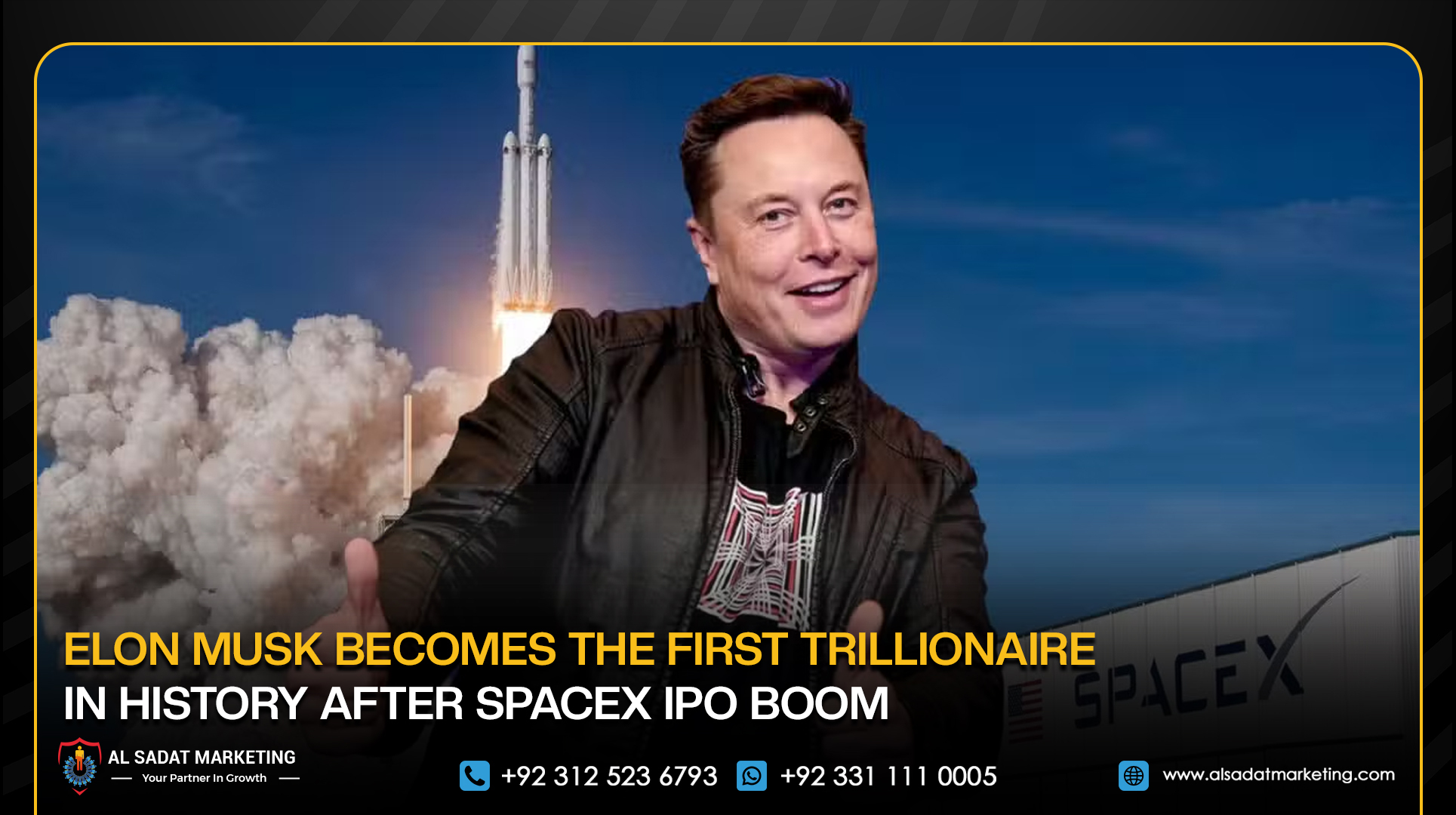
Elon Musk has become the world’s first trillionaire after SpaceX’s blockbuster stock market debut sent his net worth soaring past the $1 trillion mark.
According to the Bloomberg Billionaires Index, Musk’s fortune climbed to approximately $1.11 trillion following the successful listing of SpaceX on the Nasdaq, strengthening his position as the world’s richest person.
Historic SpaceX IPO
SpaceX made history with the largest stock market debut ever recorded, listing at a valuation of $2.2 trillion.
The company priced its shares at $135 each, but investor demand pushed the stock to open at $150, briefly touching $176.50 before closing at around $161 on its first trading day.
The offering raised an estimated $75 billion, reflecting strong investor appetite for Musk’s ambitious vision spanning space exploration, satellite communications, and artificial intelligence.
Musk’s Massive SpaceX Stake
Musk owns roughly 42% of SpaceX, giving him significant control over the company and its strategic direction.
Bloomberg estimates that his SpaceX holdings were worth approximately $767.1 billion after the IPO, alongside another $53.8 billion in stock options tied to the company.
His broader fortune also includes around $168 billion in Tesla shares and $116.4 billion in Tesla options.
Trillionaire Status Sparks Debate
The milestone has reignited discussions about wealth concentration and economic inequality.
Musk’s personal fortune now rivals the annual economic output of several nations, highlighting the extraordinary scale of wealth created through technology and capital markets.
Critics argue that such vast fortunes underscore the need for reforms to address inequality, while supporters point to Musk’s role in driving innovation across industries including electric vehicles, space technology, and AI.
Wealth Largely Exists on Paper
Despite the headline-grabbing figure, most of Musk’s fortune remains tied to the value of his company shares and stock options rather than cash.
He is restricted from selling his newly acquired SpaceX shares for at least one year, meaning the trillionaire valuation largely reflects market estimates rather than liquid assets.
The IPO is also expected to create substantial wealth for employees, with more than 4,400 current and former SpaceX workers reportedly becoming millionaires through stock-based compensation.
SpaceX Faces Financial Challenges
While investors have embraced SpaceX’s long-term potential, the company’s valuation is built heavily on future expectations.
According to financial filings, SpaceX remains unprofitable and has reportedly lost more than $9 billion over 2025 and 2026 as it invests aggressively in artificial intelligence initiatives and infrastructure expansion.
Analysts note that the company’s current market value reflects confidence in its future rather than its present earnings performance.
Beyond Rockets: Starlink and AI
Although SpaceX is best known for its reusable rockets, the company has expanded significantly beyond launch services.
Its Starlink satellite network has become a major global internet provider, while the integration of Musk’s AI venture, xAI, has pushed the company deeper into the artificial intelligence race.
SpaceX says the proceeds from the IPO will help accelerate investments in rockets, Starlink, AI technologies, and ambitious projects such as space-based data centres.
The Vision of a Multiplanetary Future
At the heart of Musk’s strategy remains an even bigger ambition: making humanity a multiplanetary species.
In its IPO prospectus, SpaceX said its mission is to develop the technologies needed to extend human presence beyond Earth and lay the foundation for what it describes as a future “lunar economy.”
The company envisions transporting people and cargo to the Moon and eventually Mars, creating entirely new economic opportunities in space.
However, SpaceX acknowledged that many of these goals rely on technologies that remain unproven and may never become commercially viable.
Investors Remain Divided
Despite concerns over valuation and profitability, investor enthusiasm drove SpaceX shares sharply higher during their debut.
Some analysts view the company as a once-in-a-generation growth story, while others caution that excitement surrounding Musk’s reputation may be outpacing financial fundamentals.
“The real test isn’t the first day of trading,” market observers noted. “It’s whether SpaceX can deliver on its extraordinary promises over the years ahead.”
For now, investors have delivered their verdict: Elon Musk’s vision remains one of the most powerful forces in global markets—powerful enough to create the world’s first trillionaire.