
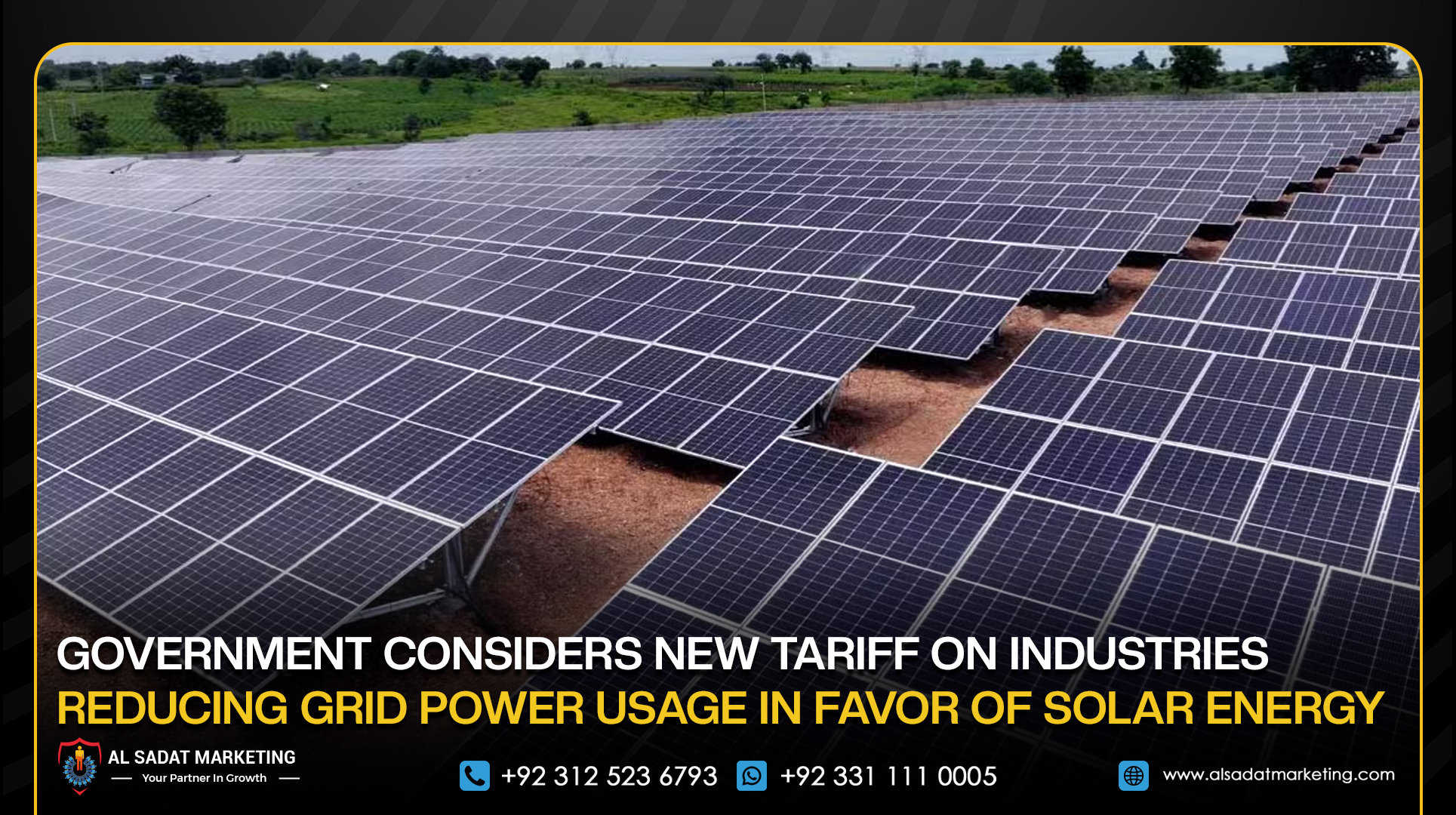
The government has proposed a new electricity pricing model that could increase fixed charges for industrial consumers that use less power from the national grid, particularly those shifting to solar energy or other alternative power sources.
The proposal, known as the two-part industrial tariff policy, has been shared with the International Monetary Fund (IMF) and is currently under discussion. According to officials, the plan aims to help recover fixed costs and capacity payments as more industries reduce their dependence on grid electricity.
Under the proposed system, industries that consume a larger share of electricity from the national grid would benefit from lower per-unit electricity rates. In contrast, businesses with lower grid consumption could face higher fixed charges, regardless of how much electricity they actually use.
A spokesperson for the Power Division confirmed that consultations are ongoing and the policy could be introduced within the next two months if approved.
The proposal comes as Pakistan’s power sector faces growing challenges from declining industrial demand. Rising electricity prices have encouraged many businesses to install solar systems or use captive power generation to reduce energy costs.
Power Minister Sardar Awais Laghari recently discussed the plan with IMF officials. The government believes that reducing energy rates while increasing fixed charges could encourage industries to remain connected to the national grid and consume more electricity.
Initially, the tariff structure would apply only to industrial consumers, although officials are considering extending similar models to commercial and residential users in the future.
According to government estimates, the policy could add around 1,000 megawatts of electricity demand within six to twelve months by encouraging higher grid usage.
Officials argue that the current tariff structure places too much emphasis on energy charges and does not adequately recover the fixed costs associated with maintaining power generation, transmission, and distribution infrastructure.
One example highlighted by officials involved an industrial consumer in Karachi who used only four units of electricity but received a bill of Rs. 8,158 due to fixed charges of Rs. 6,750. Under the proposed model, such fixed charges could increase further for consumers with low grid usage.
The IMF has expressed concern about the steady decline in industrial electricity consumption and has requested regular updates on consumption trends and the number of consumers moving away from the national grid before granting final approval.
Speaking on a television program, Power Minister Awais Laghari stated that approximately 75 percent of power generation costs are fixed, while only 25 percent are linked to actual electricity consumption. As demand falls, these fixed costs are spread across fewer consumers, resulting in higher tariffs.
The Power Division maintains that the proposed tariff would be optional rather than mandatory. Officials say the goal is to improve the use of existing power infrastructure while supporting industrial growth.
Many industrial consumers maintain high sanctioned loads but use only a portion of their available capacity. Despite lower consumption, the power sector must still maintain infrastructure capable of meeting their maximum demand, creating ongoing fixed costs.
Under the proposed framework, industries using more than 50 percent of their sanctioned load could receive a reduction of around one to two US cents per kilowatt-hour in electricity rates. This could lower effective industrial power tariffs to approximately seven to eight US cents per kilowatt-hour.
Officials say rates could fall further to nearly six US cents per kilowatt-hour for industries with even higher electricity consumption, potentially improving Pakistan’s competitiveness compared to regional markets.
The government believes the new pricing structure could benefit both the power sector and industrial consumers by aligning tariffs more closely with actual system costs.
The policy is still being finalized and will require approval from regulators and relevant authorities before implementation. If approved, energy-intensive industries and continuous-process manufacturers are expected to be among the first adopters.
Officials also expect the proposed tariff structure to influence future investment decisions regarding solar installations and captive power generation, especially if grid electricity becomes more cost-competitive during daylight hours.