
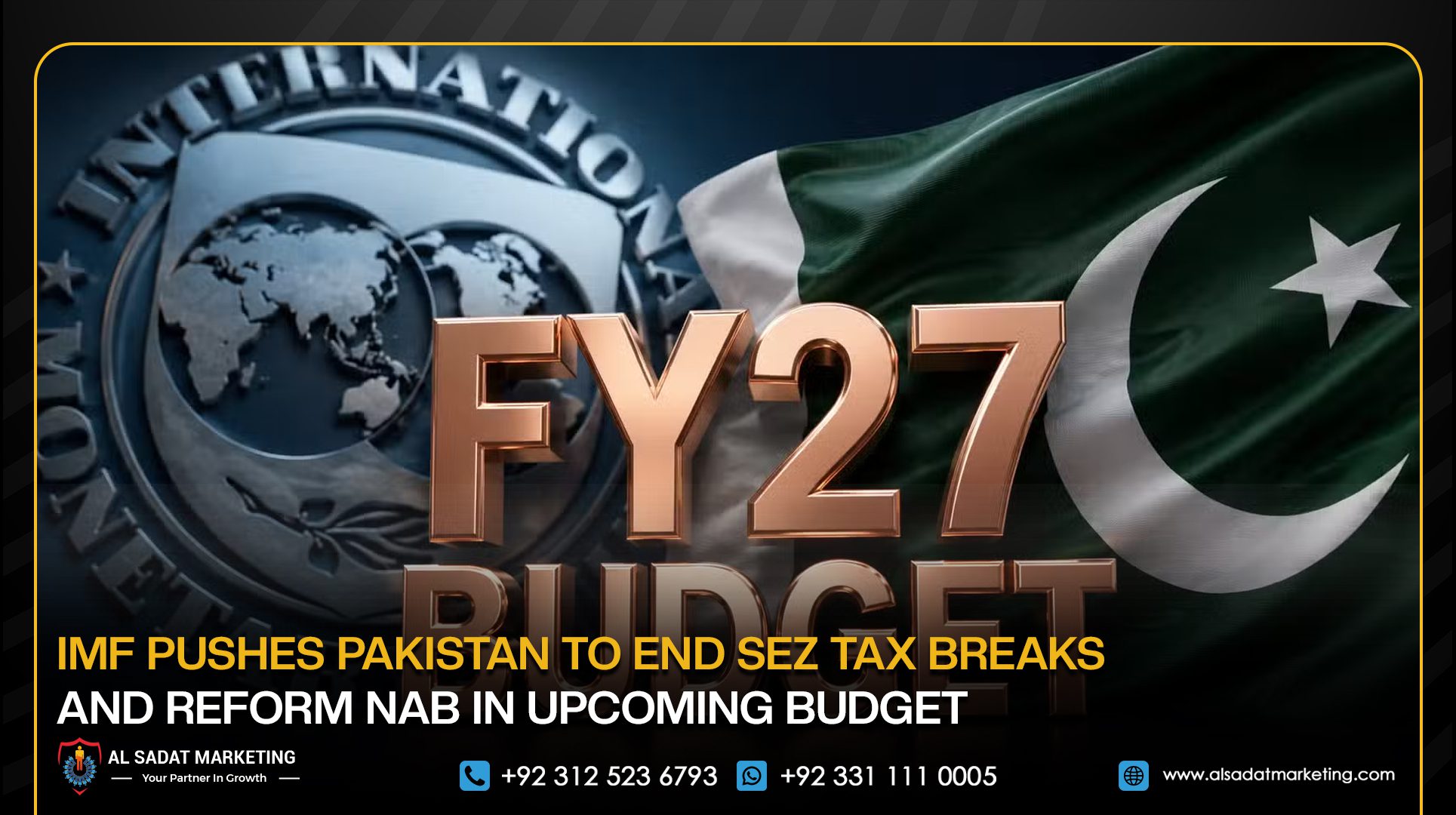
The International Monetary Fund (IMF) has set 11 new structural benchmarks for Pakistan under its ongoing Extended Fund Facility (EFF), introducing wide-ranging reforms focused on taxation, governance, energy pricing, and investment policy.
A key reform targets investment incentives, requiring Pakistan to end the authority of the Board of Investment (BOI), Board of Approval (BOA), and Special Economic Zones (SEZ) bodies from independently granting tax concessions through the upcoming federal budget. The IMF also recommends gradually phasing out existing fiscal incentives in SEZs and Special Technology Zones, shifting instead toward cost-based incentive structures, with full withdrawal of tax incentives for Special Technology Zones expected by 2035.
In the energy sector, Pakistan will continue semi-annual gas tariff adjustments and annual electricity tariff revisions to keep prices aligned with cost-recovery levels. These measures are scheduled for implementation between July 2026 and February 2027.
Governance reforms include strengthening the independence and transparency of the National Accountability Bureau (NAB). Proposed changes involve introducing a merit-based and competitive selection process for senior leadership, supervised by a multi-stakeholder committee in line with international governance recommendations. The IMF also requires publication of NAB’s investigation and prosecution procedures, along with annual statistics on corruption cases.
On fiscal management, Pakistan has committed to securing parliamentary approval for the FY2026–27 budget in line with program targets, including maintaining a primary surplus of 2% of GDP. Tax administration reforms will centralize audit selection through a data-driven Compliance Risk Management system, supported by a standardized audit manual to improve transparency and efficiency.
Procurement rules under the Public Procurement Regulatory Authority (PPRA) will also be revised to remove preferential treatment for state-owned enterprises in non-competitive contracts, aiming to ensure fair competition across the market.
Social protection measures under the Benazir Income Support Programme (BISP) will include inflation-indexed adjustments and improved benefits for the unconditional cash transfer (Kafaalat) program. Quarterly reviews will be introduced to protect low-income households from rising inflation.
Meanwhile, the State Bank of Pakistan (SBP) will develop a roadmap for gradual foreign exchange liberalization, designed to maintain macroeconomic and financial stability during the transition.
Finally, Pakistan will establish the Pakistan Regulatory Registry as a centralized, legally binding database of federal and Islamabad Capital Territory regulations, aimed at improving transparency and simplifying the business environment.