
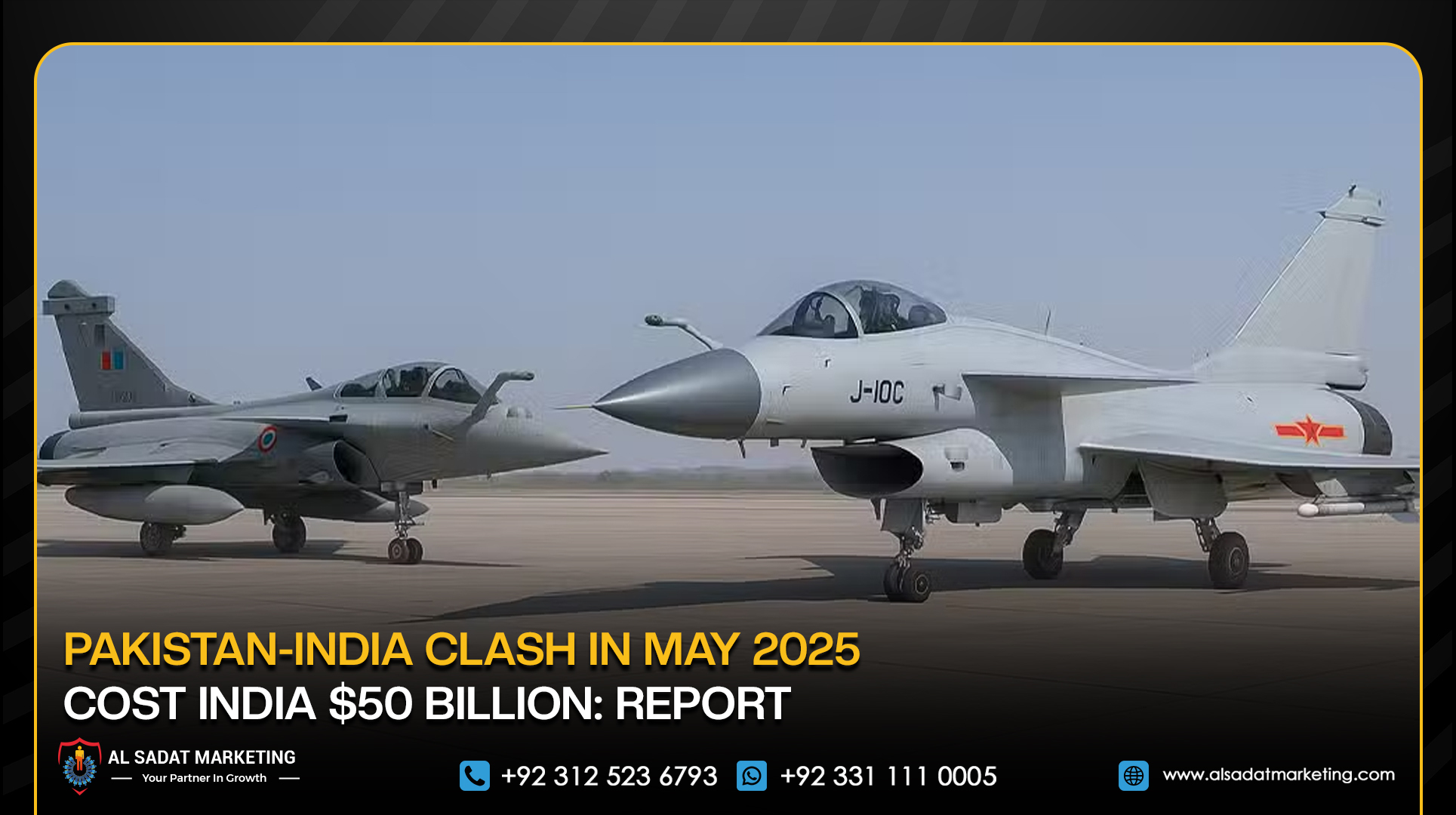
India’s military and strategic costs following the four-day conflict with Pakistan in May 2025 are estimated to have reached as high as $50 billion, driven by aircraft losses, intelligence shortcomings, and subsequent defence procurement decisions.
According to a study cited by “The Pakistan Playbook,” the brief conflict marked the first confirmed combat loss of a French-built Rafale fighter jet. International media reports, including Reuters, indicated that U.S. officials assessed with high confidence that Pakistani J-10C jets shot down multiple Indian aircraft, including at least one Rafale. A French intelligence source, cited by CNN, also acknowledged the loss.
India initially denied losing any aircraft during the engagement, but later, its Chief of Defence Staff indirectly confirmed aircraft losses during remarks at the Shangri-La Dialogue in Singapore, without disclosing details.
The study further attributes the losses in part to intelligence miscalculations, particularly regarding the operational range of China’s PL-15 beyond-visual-range air-to-air missile. Indian planners reportedly underestimated its effective range, allowing engagements from distances previously considered safe.
Financially, the report estimates India’s direct costs from the conflict and its aftermath at between $2.3 billion and $5.3 billion, depending on the number of aircraft assumed lost. Pakistan’s corresponding costs are estimated between $160 million and $420 million.
When post-conflict procurement is included, India’s total projected expenditure rises significantly, reaching between $42 billion and $50 billion. A major portion of this is linked to a proposed acquisition of 114 additional Rafale fighter jets, estimated at $36–40 billion, though the deal remains unfinalized due to reported disagreements over technical access with France.
The study argues that India’s increased defence spending reflects efforts to restore deterrence after the conflict, while noting Pakistan’s expected induction of fifth-generation fighter platforms before India fields comparable systems.
The analysis draws on official statements, international reporting, and think tank assessments, including institutions such as Reuters, CNN, The Washington Post, The New York Times, Harvard Kennedy School’s Belfer Center, and others. It also references a 2025 report by the US-China Economic and Security Review Commission, which highlighted the use of Chinese-origin military systems during the clash and pointed to tactical and doctrinal challenges faced by Indian forces.