
Pakistan’s edible oil import bill is projected to rise to around US$6 billion in fiscal year 2026, according to the Economic Survey 2025–26, highlighting the country’s continued heavy reliance on imported food commodities.
Edible oil remains one of Pakistan’s largest import categories, with domestic production meeting only about 10 percent of total national demand.
Imports exceed 3.6 million tons in 9 months
During July–March FY26, Pakistan imported 3.65 million tons of edible oil, including 0.67 million tons derived from 2.91 million tons of imported oilseeds.
The total import value of edible oil during this period stood at $3.21 billion, while imported oilseeds added another $1.34 billion, further increasing the overall import burden.
Total edible oil availability from both domestic production and imports reached 4.17 million tons during the first nine months of FY26.
Full-year outlook
Based on current trends, the government estimates that the total edible oil import bill could reach approximately $6 billion by the end of the fiscal year. Overall availability is projected at 5.36 million tons, reflecting a 15.5 percent increase compared to FY2025.
However, local production is expected to remain limited at just 0.55 million tons, keeping Pakistan heavily dependent on external supplies.
Efforts to boost local production
The Economic Survey notes some improvement in domestic oilseed output targets for FY2026. Total oilseed production is projected to rise from 474,000 tons in FY2025 to 550,000 tons in FY2026.
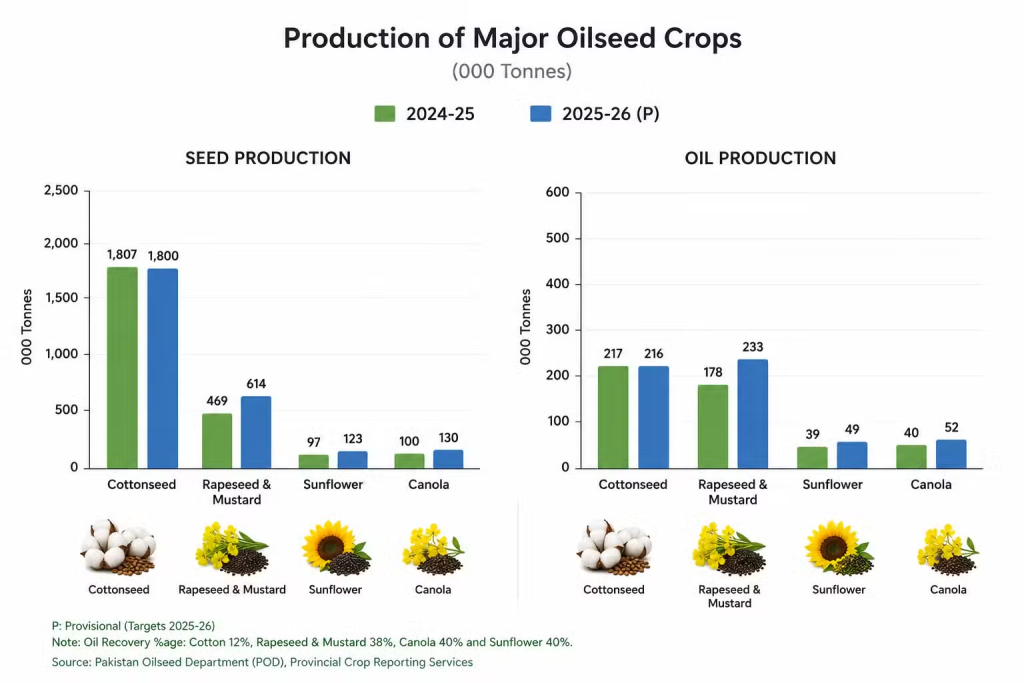
Category-wise projections include:
- Rapeseed and mustard: 178,000 → 233,000 tons
- Sunflower: 39,000 → 49,000 tons
- Canola: 40,000 → 52,000 tons
Import substitution strategy
To reduce dependence on imports, the Pakistan Oilseed Department has proposed a Comprehensive Plan for Enhancing Indigenous Production of Edible Oil, aimed at import substitution and improved food security.
The strategy targets increasing self-sufficiency from the current around 10 percent to:
- 27 percent in the short term
- 40 percent in the medium term
- 70 percent in the long term
Policy focus on agriculture reforms
The government says future progress will depend on reforms including improved agricultural financing, digital farming practices, efficient water management, and targeted oilseed cultivation programs to reduce pressure on the import bill and strengthen food security.