
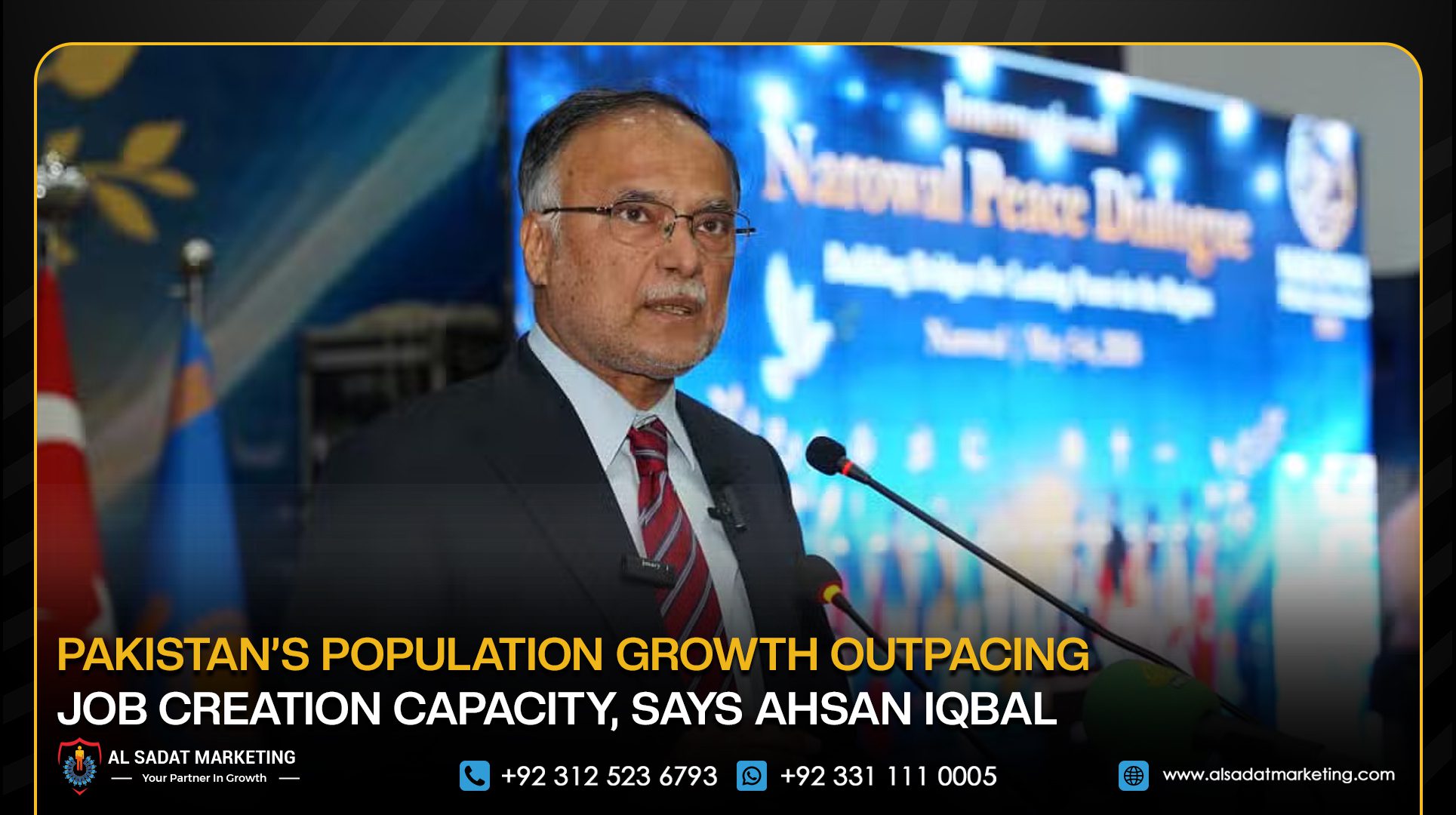
Federal Minister for Planning Ahsan Iqbal has called for introducing performance-based incentives for provinces under the NFC Award to improve population management, warning that Pakistan’s population is growing faster than its ability to generate jobs and services.
Speaking at the launch of the National and Provincial Population Projections 2023–2050 in Islamabad, he said unchecked population growth poses a serious challenge to sustainable development, economic stability, and the efficient use of national resources.
He cautioned that if current trends persist, Pakistan’s population could rise to between 370 million and 400 million by 2050, putting severe pressure on healthcare, education, employment, water, and food systems.
Ahsan Iqbal stressed that since 82 percent of NFC Award resource distribution is based on population share, the system needs reform. He proposed that provinces demonstrating better population control should be rewarded with additional incentives and recognition, noting that currently there is no mechanism to encourage reduced growth rates.
He said Pakistan is now planning its future based on a digital population census for the first time, and the new projections will play a key role in policymaking, development planning, and resource distribution. He described population not just as a statistical issue, but as a core national concern tied to economic growth, human development, and national security.
Highlighting concerns over rapid growth, he said Pakistan’s population increase now compares with some of the world’s least developed countries, which is alarming for a nuclear state. He added that earlier assumptions about slowing growth were disproven by the 2023 census, which revealed a more serious situation.
He warned that nearly 40 percent of children in Pakistan suffer from malnutrition and stunted growth, calling it a “national emergency” that requires urgent action to restore balance between population and resources.
The minister also projected that by 2050, the under-18 population could rise from 117 million to 140 million, while the working-age population may increase from 135 million to 255 million. He said that with proper investment in education, skills, and healthcare, this youth bulge could become a major demographic dividend.
He added that the projections will serve as a foundation for Uraan Pakistan, Vision 2035, the Sustainable Development Goals, future five-year plans, and upcoming NFC discussions. He emphasized the government’s focus on data-driven planning using modern technology and artificial intelligence.
Ahsan Iqbal noted that after the 18th Constitutional Amendment, population management is primarily a provincial responsibility, and urged provincial governments to take practical steps while NFC reforms should reward better performance.
He also called on media, researchers, and civil society to raise awareness about population issues, warning that unchecked growth could become a major social and economic burden and result in an unskilled workforce if not addressed.
The event was attended by Health Minister Mustafa Kamal, Planning Commission officials, representatives of the UN Population Fund, experts, and members of civil society.