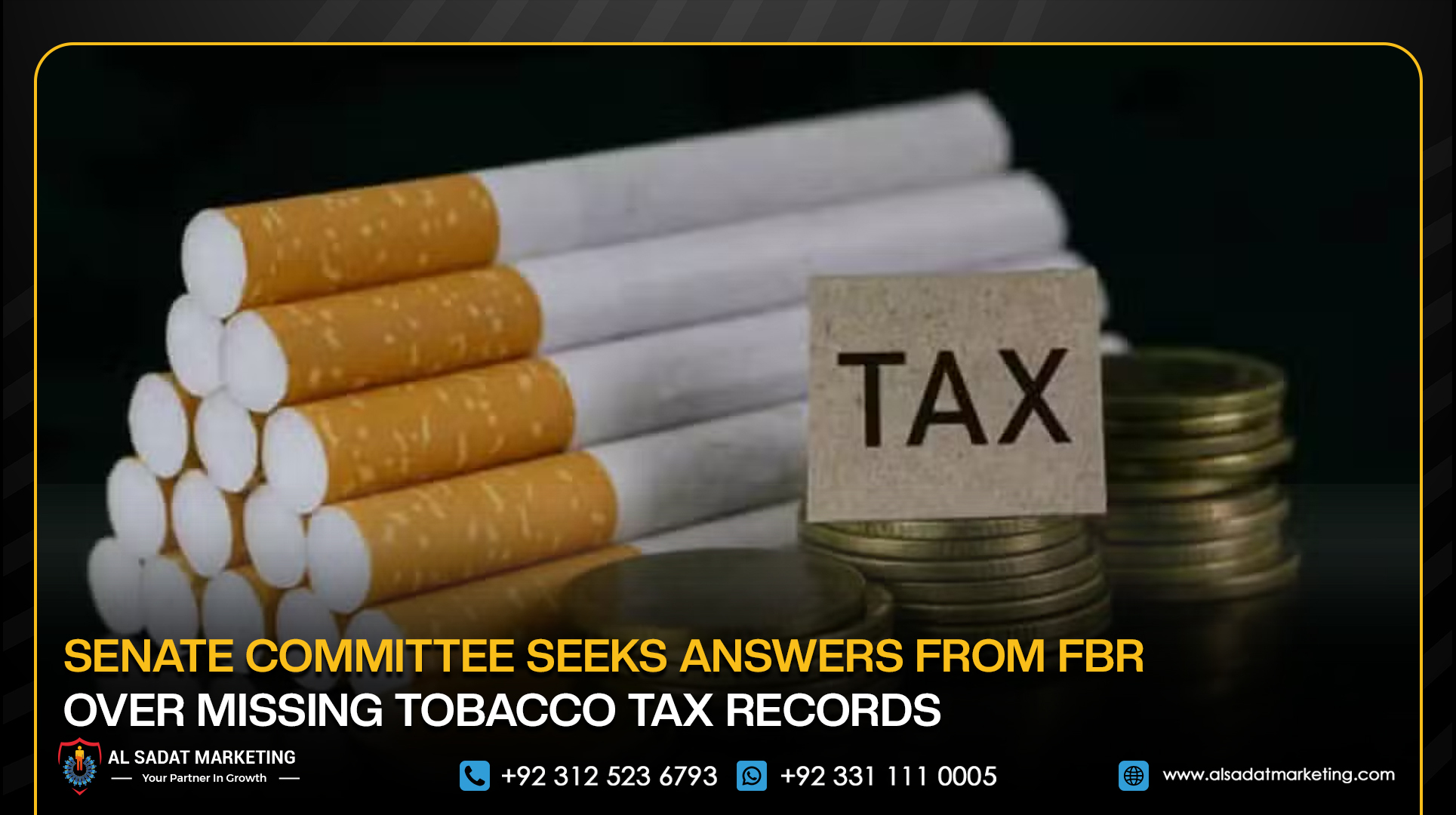
A sub-committee of the Senate Standing Committee on Interior and Narcotics has directed the Federal Board of Revenue (FBR) to submit detailed records of taxes assessed, collected, and still outstanding from Pakistan’s tobacco industry over the past two decades.
The committee expressed dissatisfaction with the FBR’s repeated failure to provide a comprehensive briefing on tax collection from tobacco manufacturers. During the meeting, lawmakers noted that despite previous directives, the tax authority had not presented the required information regarding tobacco tax revenues.
The panel has sought complete details of all registered tobacco factories operating during the last 20 years, along with records of taxes assessed, recovered, and pending against the industry.
The meeting, held at the Old PIPS Hall in Parliament Lodges, also took serious notice of the FBR’s inability to provide data on tax evasion in the tobacco sector. Javed Iqbal Tarar, Chief Sales Tax at the FBR, was unable to present the requested information and was subsequently asked to leave the meeting.
Committee members reviewed tax evasion in the tobacco industry, public awareness campaigns, narcotics control initiatives, and enforcement measures undertaken by relevant government departments.
Officials from the Press Information Department (PID) informed the committee that awareness campaigns against illegal cigarette sales had been conducted on behalf of the FBR across 92 television channels and other media platforms. They clarified that the respective ministries and divisions financed all campaign expenditures.
The committee directed the PID to submit complete records of media contracts, campaign spending, and agreements signed with television channels.
Members were also informed that the FBR had deployed Rangers personnel to assist in tackling tax evasion within the tobacco sector. During the discussion, Senator Abro referred to earlier briefings in which Pakistan Customs reported tobacco-related taxes of Rs. 75 billion, while later discussions suggested that approximately Rs. 40 billion remained unpaid.
The committee instructed the FBR to provide documentary evidence regarding outstanding taxes, a complete list of tobacco companies and their brands, details of imported raw materials, and revenue collection records covering the last 20 years.
In addition, the committee directed the Federal Investigation Agency (FIA) to investigate allegations of corruption involving Badshah Wazir. The inquiry will focus on claims that raw materials imported for tax-exempt areas never reached their intended destinations.
Senator Talha Mahmood emphasized that all committee proceedings should remain impartial and supported by verifiable evidence.
On the issue of narcotics control, Punjab Police submitted a consolidated report covering the last two decades. The report included data on drug seizures, registered cases, convictions, pending trials, and the disposal of confiscated narcotics.
Officials informed lawmakers that the Anti-Narcotics Force (ANF) accounted for nearly 49 percent of Pakistan’s total narcotics seizures during the previous year. They also highlighted an increasing shift from traditional plant-based drugs toward synthetic and chemical narcotics.
The committee discussed the possibility of utilizing confiscated narcotics for pharmaceutical research or medical purposes where permitted under the law instead of destroying them entirely.
The DIG South Karachi briefed the committee on anti-narcotics operations conducted between 2013 and 2026, stating that authorities had registered more than 105,000 narcotics cases and arrested around 127,000 suspects during the period.
Lawmakers also reviewed the high-profile drug trafficking case involving Anmol, also known as Pinky. Expressing concern over conflicting accounts of her arrest, the committee questioned why she received extensive police security during court appearances and directed law enforcement agencies to investigate her alleged connections with influential individuals.
Officials revealed that 28 criminal cases had been registered against Anmol, while 35 delivery riders linked to her alleged drug network had been arrested. They further claimed that several Nigerian nationals residing in Lahore’s Nishtar Colony were also associated with the network.
Senator Talha Mahmood additionally requested detailed import and export data from Pakistan Customs. He raised concerns over the under-invoicing of mining raw materials and sought comprehensive information on trade conducted through the Sust border and Pakistan’s commercial activities with Iran.
At the conclusion of the meeting, the committee summoned the Inspectors General of Police from Sindh, Punjab, and Balochistan to attend its next session. All relevant departments were instructed to submit the requested records and reports before the upcoming meeting.