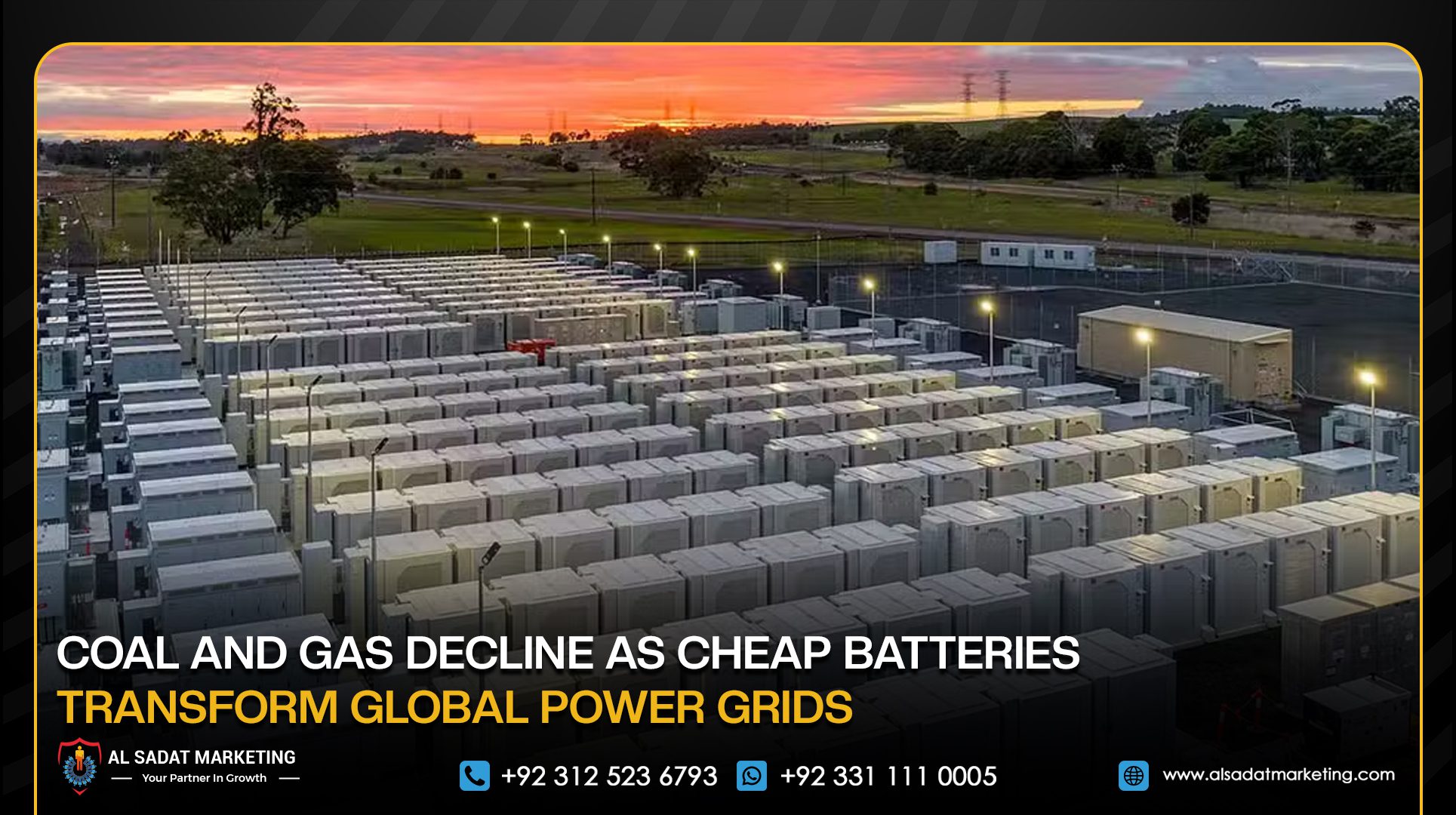
A global boom in large-scale battery storage projects is expected to transform power systems in 2026, with major installations planned in regions such as Texas, Inner Mongolia, and New South Wales.
Falling battery costs, rising electricity demand, and global geopolitical tensions are accelerating growth, making battery storage a key part of the future energy mix.
According to BloombergNEF, worldwide battery installations are projected to increase by around one-third this year, with strong expansion across Europe, the Middle East, Africa, and Latin America. Demand could rise even faster if disruptions in fossil fuel supplies continue.
The shift is being driven by a steep drop in battery prices, which have fallen roughly 75 percent since 2018 and are expected to decline further in the coming years.
At the same time, electricity demand is increasing rapidly, especially due to data centers, creating pressure on power systems to adopt faster and more flexible energy solutions.
Battery storage allows electricity to be saved when prices are low, such as during peak solar or wind generation, and released when demand rises. This reduces dependence on coal and gas while improving grid reliability.
Several major projects are already underway. In Inner Mongolia, multiple battery sites with a combined capacity of 7.4 gigawatt-hours have started operations. In Australia, the Waratah Super Battery has already shown strong results by supplying more power during peak demand than gas plants shortly after partial launch. It is expected to become fully operational in 2026.
China remains the dominant player in the sector, producing most of the world’s batteries and accounting for a large share of installations. Oversupply from Chinese factories has helped lower prices globally.
In the United States, the expansion of data centers is driving higher electricity demand. Many new facilities are relying on renewable energy paired with battery storage as delays affect traditional power plants. Batteries are expected to account for more than one-quarter of new power capacity added in the US in 2026.
Europe is also experiencing rapid growth, as rising renewable generation creates challenges for older grid systems. Battery projects are helping manage supply fluctuations and reduce wasted energy.
New technologies are also emerging. Companies such as Form Energy are developing long-duration batteries that can store electricity for extended periods, improving reliability during shortages.
Despite strong momentum, challenges remain, including dependence on China’s supply chain, slow grid connections, regulatory barriers, and high financing costs.
Even so, battery storage is becoming increasingly important as electricity demand rises, renewable energy expands, and fossil fuel use declines. Experts say batteries will play a central role in maintaining stable and reliable power systems worldwide.