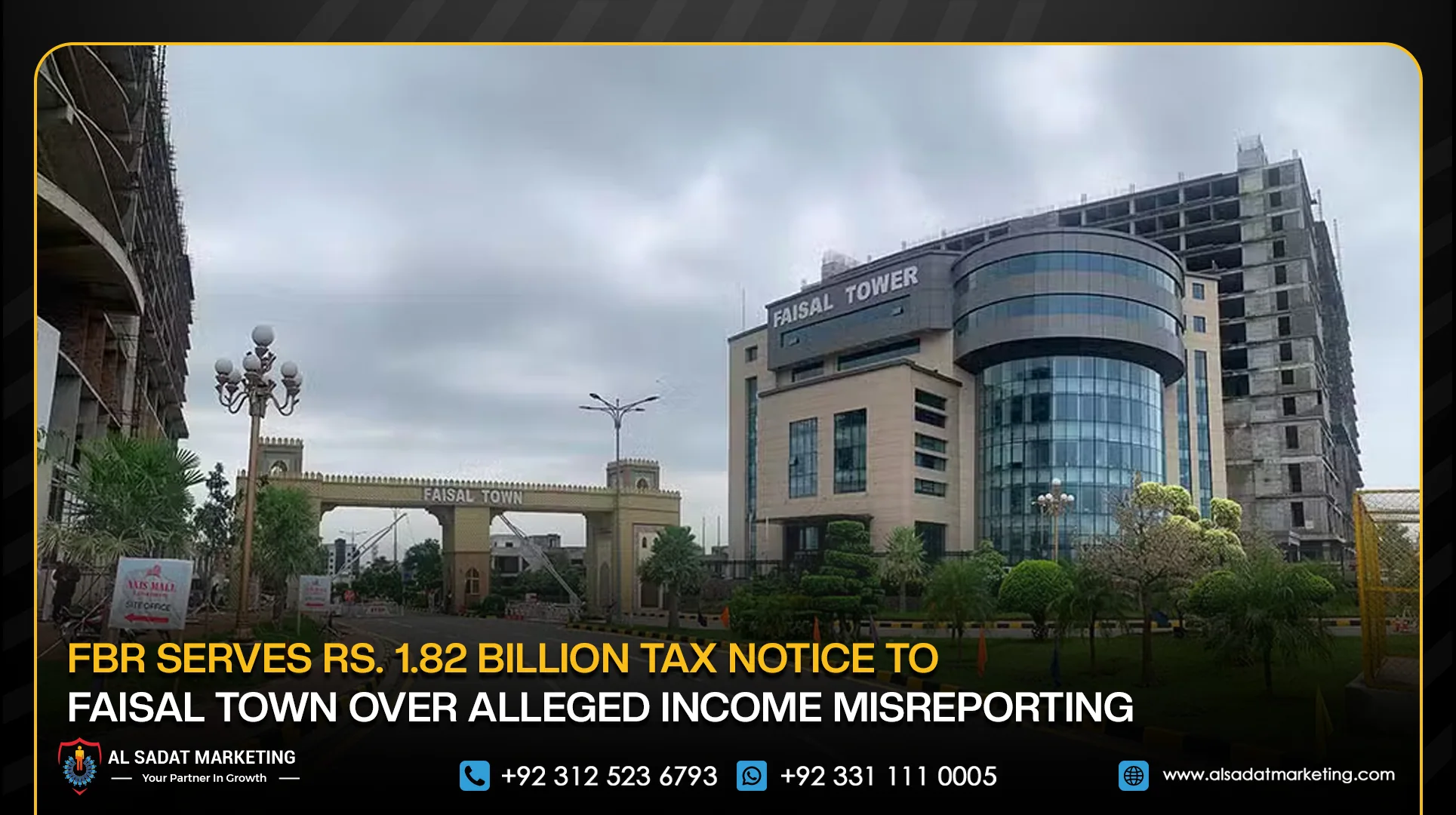
ISLAMABAD: The Federal Board of Revenue (FBR) has raised an income tax demand of approximately Rs. 1.82 billion against Faisal Town (Private) Limited, alleging that the real estate developer understated its taxable income for Tax Year 2020 through an incorrect revenue recognition method.
According to an assessment order issued by the Large Taxpayers Office (LTO) Islamabad, the tax authority amended the company’s assessment after determining that its declared income recognition resulted in a significant understatement of taxable income.
The tax demand relates to a dispute over the Percentage of Completion (POC) method used to calculate revenue from long-term property development projects.

Dispute Over Project Cost Estimates
According to the FBR assessment, Faisal Town initially estimated the total development cost of the project at approximately Rs. 40.46 billion, covering an area of 9,189 kanals.
During the tax assessment, however, the company revised the estimated development cost to approximately Rs. 90.46 billion, citing an expansion of the project’s area to 25,944 kanals.
The FBR said the revised cost estimate significantly changed the project’s calculated completion ratio. Based on the revised figures, the completion ratio fell from 44.73% to 19.95%, resulting in substantially lower revenue and taxable income being recognised for Tax Year 2020.
The tax authority rejected the revised figures, stating that the company had not provided sufficient supporting evidence to justify the significant increase in estimated development costs.
According to the assessment order, the required supporting documentation—including feasibility studies, board approvals and contemporaneous cost estimates—was not adequately provided to substantiate the revised estimate.
RDA Approval Also Questioned
The FBR further questioned the timing of the revised project figures.
The authority noted that the revised approval from the Rawalpindi Development Authority (RDA) was issued in January 2021, after the close of Tax Year 2020.
On this basis, the tax authority concluded that the subsequent approval could not be applied retrospectively when determining the company’s taxable income for the earlier tax year.
The FBR also raised concerns over the commercial consistency of the revised estimates.
According to the assessment, the projected development cost increased from Rs. 40.46 billion to Rs. 90.46 billion, while the company’s declared total project revenue remained unchanged at approximately Rs. 45.91 billion.
The tax authority considered this combination of figures inconsistent and used the original project cost estimate in recalculating the completion ratio.
FBR Recalculates Taxable Income
Using the original estimated development cost of Rs. 40.46 billion, the FBR recalculated the project’s completion ratio at 44.73%.
Based on its assessment, the authority determined Faisal Town’s taxable income for Tax Year 2020 at approximately Rs. 6.14 billion.

Applying the applicable corporate income tax rate of 29%, the FBR calculated a tax liability of approximately Rs. 1.82 billion.
The demand relates to the income-recognition dispute and is separate from other potential audit-related additions or adjustments that may be considered separately.
Developer’s Response
The assessment represents the FBR’s position in the tax dispute. Faisal Town may have the opportunity to challenge the assessment through the relevant legal and tax appeal mechanisms.
The property developer was contacted for a response regarding the FBR’s assessment. Its position can be incorporated once an official response is received.
The case highlights the importance of revenue-recognition methods, project cost estimates and supporting documentation in determining taxable income for large-scale real estate development projects.
For property-sector companies undertaking long-term developments, the dispute also underscores the significance of maintaining contemporaneous financial records and documentary evidence supporting changes in project scope, development costs and revenue-recognition assumptions.